5 Organic Chemistry Reactions Every NEET Aspirant Must Master
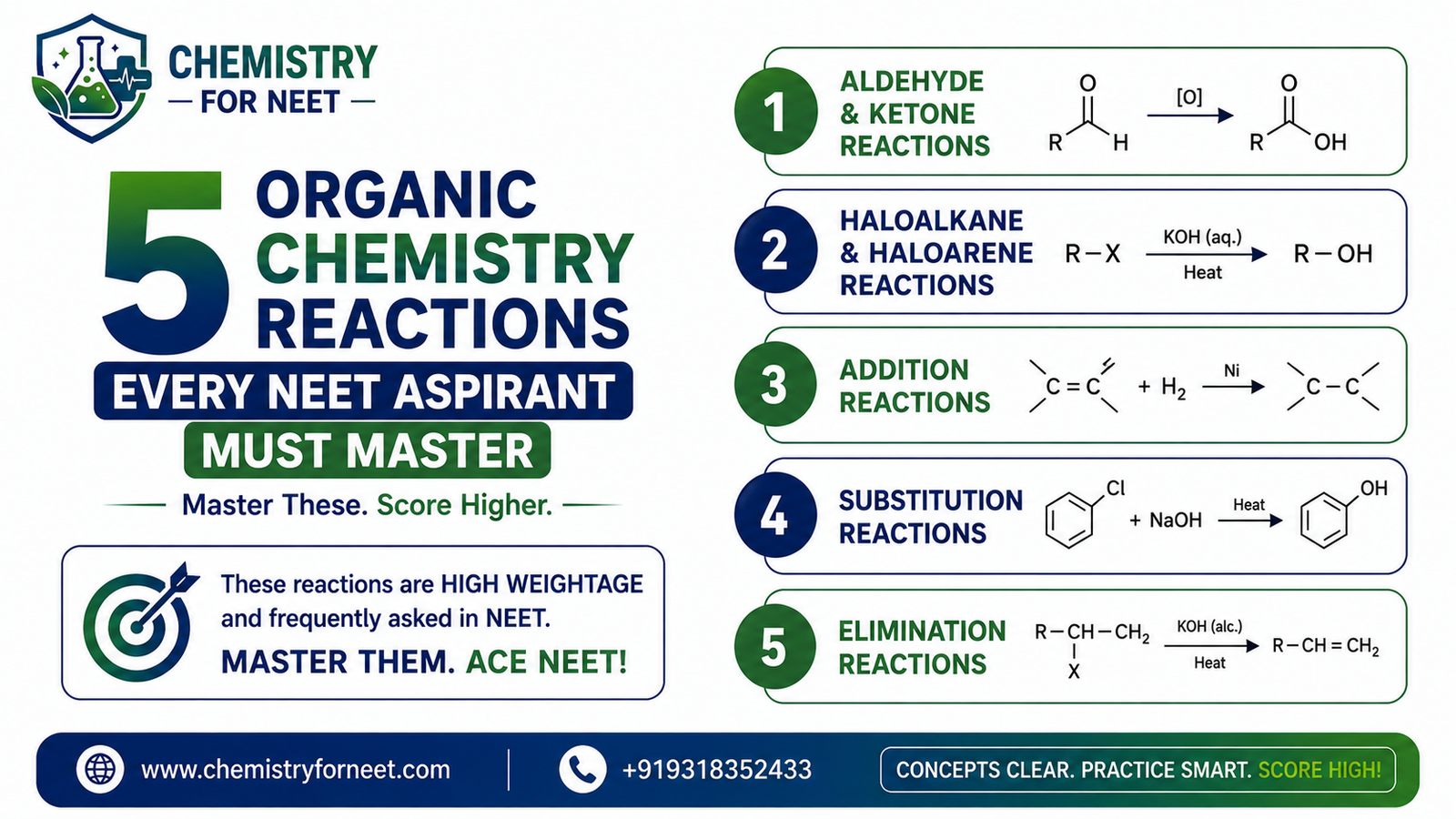
Table of Contents
Ask any NEET topper which part of Organic Chemistry actually decided their score, and you'll rarely hear "the chapter I memorised best." You'll hear the name of a specific reaction — the one that kept showing up, in slightly different disguises, until it finally clicked. After 18 years of teaching organic chemistry reactions for NEET, I can point to five must know organic reactions for NEET that account for a disproportionate share of the marks in this section, year after year. Learn these five properly, not just recognise them, and a genuinely large chunk of Organic Chemistry stops being unpredictable.
This isn't a random organic chemistry reaction list for NEET pulled from a syllabus index. Based on our own chapter-wise weightage analysis, these five important organic chemistry reactions for NEET, and the neet organic chemistry important reactions closely related to each one, turn up directly or in a disguised form across Haloalkanes, Hydrocarbons, Aldehydes and Ketones, and Amines — which means mastering them properly pays off across multiple chapters at once, not just one. If you'd rather have all of this taught to you directly, with the organic chemistry reaction mechanisms for NEET actually drawn out live, that's exactly what my online chemistry classes are built around.
One thing before we start: none of these five reactions are optional or "nice to have," whether you're looking at the top organic chemistry reactions for NEET 2026 or the top organic chemistry reactions for NEET 2027. These aren't obscure organic chemistry named reactions for NEET that occasionally show up either — they're consistently among the high weightage organic chemistry topics for NEET, chapter after chapter. If your organic chemistry preparation for NEET is missing any one of them, that's a specific, fixable gap, not a reason to panic — but it is worth fixing before it costs you marks you didn't need to lose.
1. Nucleophilic Substitution: SN1 vs SN2
If I had to pick one topic that quietly decides how comfortable a student feels with the entire Haloalkanes chapter, it's this one. NEET doesn't usually ask you to name the mechanism outright — it asks a question that only makes sense if you already know which pathway a given substrate actually prefers.
The Mechanism: Why SN1 and SN2 Behave So Differently
SN2 happens in one clean step — the nucleophile attacks from the opposite side of the leaving group, flips the molecule's configuration like an umbrella caught in the wind, and the whole thing is over in a single transition state. SN1 is messier and slower to start: the leaving group departs first, forming a carbocation, and the nucleophile attacks afterward, from either face, which is why SN1 products often come as a mix of two configurations rather than one clean inversion.
The NEET Trap: Primary vs Tertiary Halides
The trap NEET sets, reliably, involves substrate structure. A primary halide has almost no room for a carbocation to form comfortably, so it defaults to SN2. A tertiary halide forms a comfortable, stabilised carbocation far too easily to bother with the crowded, one-step SN2 route, so it defaults to SN1. Students who've memorised this as a rule without understanding why get tripped up the moment NEET adds a polar protic solvent or a strong versus weak nucleophile into the same question. Secondary halides are the genuinely tricky middle case, where the actual answer usually comes down to whichever factor, solvent or nucleophile strength, the question is testing that particular year.
A Quick Way to Remember Which Pathway Wins
I tell students to picture crowding, not memorise a rule. A crowded carbon (tertiary) can't let a nucleophile approach from the back easily, so SN2 is physically awkward there — SN1 wins. An open, uncrowded carbon (primary) has nothing stopping a clean back-side attack, so SN2 wins, and there's rarely a stable enough carbocation to make SN1 worthwhile anyway. Once you picture it this way instead of reciting it, the exceptions start making sense instead of needing to be separately memorised.
Pro Tip from S.K. Sir:
Before answering any substitution question, write "1°, 2°, or 3°?" in the margin first. Ninety percent of the time, identifying the substrate correctly answers the mechanism question before you've even looked at the nucleophile or solvent.
2. Electrophilic Aromatic Substitution
Benzene's reactions look intimidating because there are several named versions — nitration, halogenation, sulphonation, Friedel-Crafts alkylation and acylation — but underneath, they all follow the same mechanism with a different electrophile plugged in. Students who treat each one as a separate reaction to memorise end up doing five times the work for a single underlying idea.
The Mechanism Behind Nitration, Halogenation, and Friedel-Crafts
Every one of these reactions starts the same way: a strong electrophile attacks the electron-rich benzene ring, briefly breaking its aromaticity to form an unstable intermediate called an arenium ion, before a proton leaves and aromaticity is restored. Learn this shared mechanism once, properly, and every named variation becomes a matter of recognising which electrophile is involved, rather than memorising five separate reaction sequences from scratch. A nitronium ion for nitration, a halogen activated by a Lewis acid catalyst for halogenation, an acylium or carbocation for Friedel-Crafts — the ring's behaviour toward each one is identical.
Why the Directing Group Question Keeps Coming Back
NEET's favourite question here isn't the mechanism itself — it's which position a second substituent will occupy once the ring already has one group attached. Electron-donating groups direct incoming electrophiles to the ortho and para positions; electron-withdrawing groups direct to the meta position. This single rule, applied correctly, solves the overwhelming majority of directing-group questions NEET has asked over the past decade, and it's worth memorising as a rule you understand, not a fact you've rote-learned without knowing why it holds.
3. Aldol Condensation
Aldol Condensation is where a lot of students first discover that Aldehydes and Ketones aren't just about oxidation and reduction — this reaction is really GOC, applied to a carbonyl group, and it rewards students who genuinely understood GOC months earlier in their preparation.
What Actually Happens, Step by Step
An aldehyde or ketone with at least one alpha-hydrogen loses that hydrogen under basic or acidic conditions, forming an enolate or enol that then attacks a second carbonyl molecule as a nucleophile. The immediate product, called the aldol, is a beta-hydroxy carbonyl compound, which can lose water on heating to form an alpha, beta-unsaturated carbonyl compound — the actual "condensation" step that gives the reaction its name. Notice that this is, at its heart, the enol or enolate acting as a nucleophile toward a fresh carbonyl group, which is the same electron-rich behaviour you'd expect if you actually understood GOC properly beforehand.
Spotting an Aldol Question Before You've Finished Reading It
The single fastest identifying feature: does the starting carbonyl compound have an alpha-hydrogen? If yes, an Aldol reaction is on the table the moment you see a base in the reagents. If the question mentions heating after the base, expect the dehydrated, unsaturated product rather than the simple aldol — this small detail is exactly where NEET likes to test whether a student read the question carefully or just recognised the reaction name and stopped reading. A crossed aldol, involving two different carbonyl compounds, is a slightly harder variant worth practising separately once the basic version feels comfortable.
4. The Cannizzaro Reaction
This reaction only exists because of a gap the Aldol reaction leaves behind, which is exactly why I teach it immediately after Aldol Condensation, not as an isolated topic covered weeks later.
Why Aldehydes Without an Alpha-Hydrogen Behave Differently
An aldehyde with no alpha-hydrogen, formaldehyde or benzaldehyde being the classic examples, simply can't undergo Aldol Condensation, because there's no acidic hydrogen for a base to remove. Instead, under a strong base like concentrated sodium hydroxide, two molecules of the aldehyde react with each other directly: one gets oxidised to a carboxylate salt, the other gets reduced to the corresponding alcohol, in the same reaction, simultaneously. It's a genuinely elegant workaround once you see it, because the molecule that can't self-condense finds another molecule of itself to react with instead.
The One Detail That Decides If It's a Cannizzaro Question
Whenever a NEET question shows an aldehyde reacting with concentrated NaOH or KOH, the very first thing to check is whether that aldehyde actually has an alpha-hydrogen. No alpha-hydrogen means Cannizzaro. An alpha-hydrogen present means you're almost certainly looking at an Aldol question instead, dressed up to look similar. This is a genuinely common source of careless marks lost, purely from not checking this one detail before answering, and it's one of the fastest checks in this entire article to actually apply under exam time pressure.
5. Hofmann Bromamide Degradation
Amines is often the last major organic chapter students cover, which means preparation for it sometimes gets rushed right when exam pressure is highest — and this particular reaction is too high-yield to let that happen to your preparation.
The Mechanism, Simplified
An amide reacts with bromine and a strong base, typically sodium hydroxide, and the entire carbon chain shortens by one carbon in the process, converting the amide directly into a primary amine with one fewer carbon than the starting material. The mechanism runs through a nitrene intermediate, which then undergoes a rearrangement, but for NEET purposes, the detail worth actually memorising is the net outcome: one carbon lost, an amide becomes an amine. Students often confuse this with simple amide hydrolysis, which doesn't change the carbon count at all — checking whether the product has one fewer carbon than the reactant is usually enough to tell the two apart.
Why This Reaction Shows Up in Amines Almost Every Year
Hofmann Bromamide Degradation is one of the few named reactions where NEET can test both organic transformation logic and nomenclature in a single question, which makes it a genuinely efficient question for the examiner to set. Expect it to appear either as a direct "what is the product" question or folded into a synthesis sequence where recognising the carbon-count drop is the key to getting the rest of the sequence right.
Turning These Five Reactions Into an Actual Revision Plan
Knowing five reactions and being able to reproduce them under exam pressure, three months from now, are different things. A proper organic chemistry revision for NEET plan treats these five as a recurring checklist, not a one-time lesson to tick off and move past. Most students learn a reaction properly once, feel confident about it for a week or two, and then let it quietly fade because nothing in their routine brings them back to it.
The Organic Chemistry Reaction Tricks That Actually Hold Up
Every one of the five reactions above has exactly one identifying question worth asking before you touch a pen: is there an alpha-hydrogen, is the substrate primary or tertiary, is the ring electron-rich or electron-poor. These are the organic chemistry reaction tricks for NEET I actually use with students, because they're genuinely diagnostic rather than being a vague "look for keywords" style shortcut that falls apart the moment NEET phrases something unusually. An easy way to remember organic reactions for NEET isn't a longer list to memorise — it's a shorter list of questions to ask, applied consistently, every single time.
Building Your Own Organic Chemistry Reaction Chart
I do recommend building an organic chemistry reaction chart for NEET, but as a personal reference you create yourself, chapter by chapter, rather than one you print out and hope to absorb by osmosis. Writing a chart forces you to actually recall each mechanism from memory rather than recognise it on a page, and that act of recall is what makes the chart worth the time it takes to build. Keep it to one page per reaction, mechanism sketched from memory, and revisit it weekly rather than daily.
Using Organic Chemistry PYQs for NEET the Right Way
Working through organic chemistry pyqs for NEET is where all of the above actually gets tested. Rather than solving previous year questions in the order they appear on a paper, pull out every set of neet chemistry reaction questions tied to one specific reaction and solve them together, back to back. This chemistry preparation for NEET organic section approach reveals an examiner's specific habits for that one reaction far faster than solving a mixed set of unrelated organic questions, and it's the single biggest shift I've seen move a student's organic score in a short window of time.
Frequently Asked Questions
Are these really the five most important organic reactions for NEET, or just five examples?
These five specifically, based on how consistently they and their close variations appear across NEET organic chemistry pyqs going back a decade. There are other important reactions worth knowing, but these five carry a disproportionate share of the actual marks relative to how much time they take to master properly, which is really the whole point of prioritising anything in a syllabus this large.
Do I need to memorise every mechanism in full detail, or just the products?
Memorising products without the mechanism is a fragile strategy, because NEET regularly rephrases a question just enough that pure memorisation falls apart. A concept based organic chemistry for NEET approach, where you actually understand why a product forms, survives a rephrased question in a way rote memorisation doesn't, and it tends to transfer to reactions you haven't explicitly studied too.
Is there a shortcut to remembering all five without a full organic chemistry reaction chart?
A chart helps as a reference — our own organic chemistry study notes for NEET include mechanism flowcharts for exactly this reason — but the actual shortcut is pattern recognition, not a bigger chart to memorise. Each reaction above has a single identifying feature, and training yourself to check that one feature first is faster and more reliable than trying to recall an entire chart under exam pressure, when time is the one thing you don't have to spare.
How should I use previous year questions to practise these five reactions specifically?
Filter PYQs by reaction rather than solving them in whatever order they appear in a paper. Solving every Cannizzaro-related neet chemistry reaction question from the last ten years back to back reveals the examiner's specific patterns for that one reaction far faster than mixing it in with unrelated organic questions, and the same approach works just as well for each of the other four.
Where do these five reactions fit into a broader organic chemistry reaction roadmap for NEET?
They sit near the end of a roadmap that should start with GOC, move through Hydrocarbons, and only then reach Haloalkanes, Aldehydes and Ketones, and Amines, since all five reactions above assume a working understanding of GOC first. Trying to learn them before GOC is solid tends to produce memorisation rather than understanding, which usually shows up as confusion the moment a question looks even slightly unfamiliar.
Should I learn these from self-study notes or from a structured class?
Either can work, provided the source actually explains mechanism rather than just listing reagents and products. I'd say this as someone who runs organic chemistry coaching for NEET myself: the best organic chemistry teacher for NEET, whether that's me or someone else entirely, is whoever actually walks through the reasoning live, answers a follow-up question on the spot, and doesn't just hand you a static organic chemistry reaction chart for NEET and call it done.
Want These Reactions Actually Taught to You, Mechanism by Mechanism?
Reading about a mechanism and being able to reproduce it under exam pressure are two different skills, and that gap is exactly where most students lose marks on questions they technically "knew." These five reactions are a genuinely good starting point, but they're five out of a much longer list that the rest of the syllabus will eventually demand. If you'd like the best organic chemistry mentor for NEET you can find to walk through these five reactions, and the rest of the syllabus, with you directly, I'd be glad to have you in the next batch.
Book a Free Demo Class