How to Score 170+ in NEET Chemistry
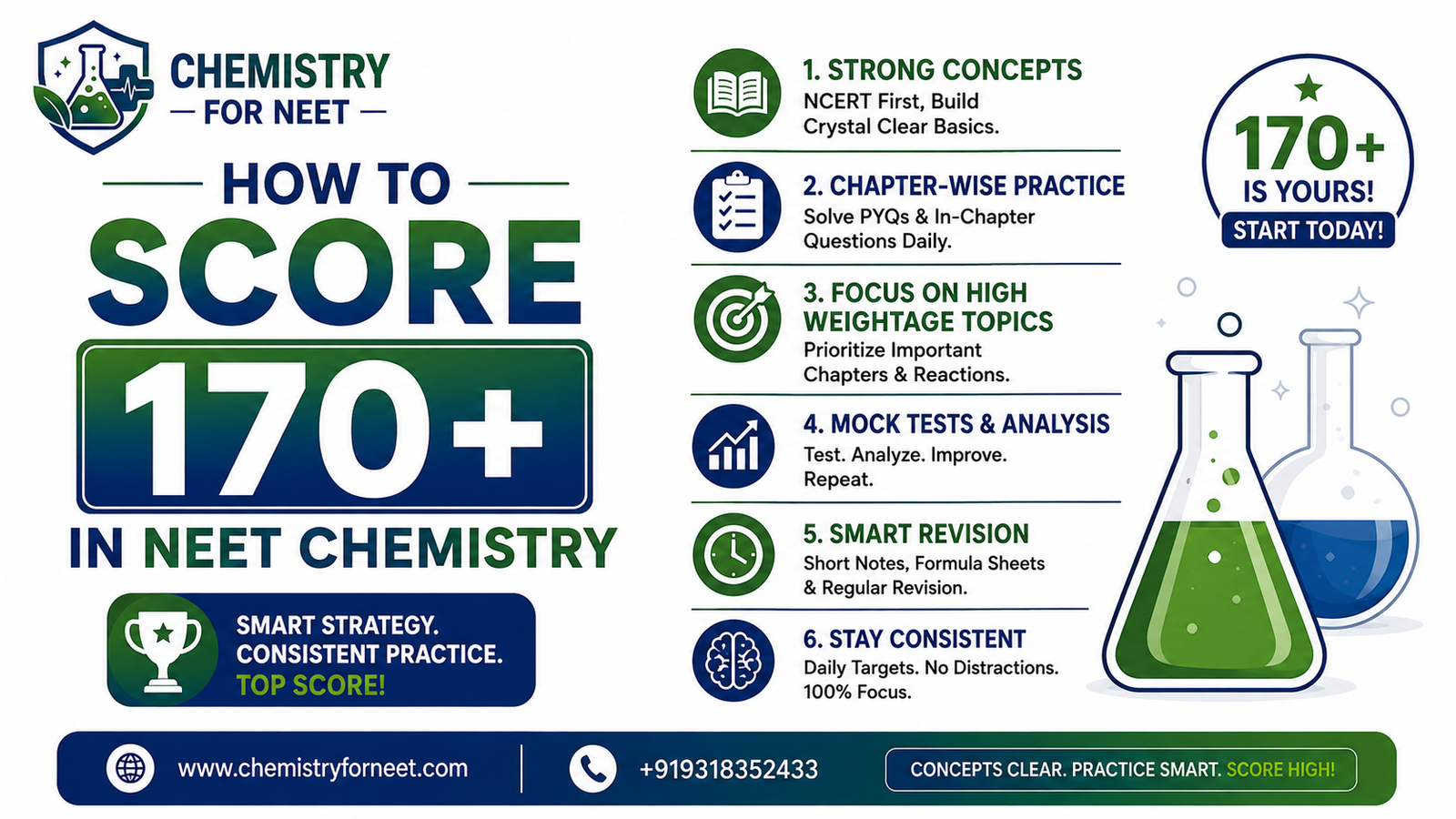
Table of Contents
Scoring 170+ out of 180 in NEET Chemistry isn't a miraculous event reserved for geniuses. It's the mathematical byproduct of a highly disciplined, structurally sound strategy — and I've watched it happen enough times now, across enough different kinds of students, to say that with real confidence rather than as a marketing line. With over 18 years of experience mentoring thousands of medical aspirants, I can tell you definitively that Chemistry is the highest-scoring subject in the NEET exam, if, and only if, you respect its tripartite nature instead of treating it as one uniform subject. Most students don't fail Chemistry because they lack ability. They fail because they prepare for three genuinely different subjects using one identical method.
Unlike Physics, which is overwhelmingly mathematical, or Biology, which is heavily memory-based, Chemistry asks you to switch between three genuinely different cognitive gears within the same 45 minutes: the logic of Physical Chemistry, the mechanistic flow of Organic Chemistry, and the factual retention of Inorganic Chemistry. Most students prepare for all three the same way, usually by reading and re-reading, and that's precisely why most students plateau somewhere around 130 to 140 instead of pushing past 170. I've sat across from enough of these students, mock test papers in hand, to know the plateau almost always traces back to the same root cause: treating a mechanistic subject like a memory subject, or a logical subject like a memory subject, and wondering why the marks won't move.
In this guide, I'll break down the exact blueprint I use with my own students to secure that elite 170+ score and, with it, a real shot at a seat in a top government medical college. None of this is theoretical — it's the same sequence I've refined, adjusted, and re-tested across nearly two decades of actually watching what moves a score and what doesn't. Read it once for the overview, then come back to specific sections as you actually work through each chapter, because most of this advice makes more sense with a textbook open next to you than it does read cold in one sitting.
Phase 1: Conquering Physical Chemistry
Physical Chemistry scares biology-leaning students because of the calculations, and the NTA knows this. They exploit it by framing questions with complex-looking decimals that seem to demand a calculator you're not allowed to bring into the exam hall. Here's the secret nobody tells you early enough: the NTA rarely wants you to calculate to three decimal places. They're testing your ability to approximate quickly, not your arithmetic precision. Once that distinction actually sinks in, a genuinely intimidating chapter like Electrochemistry starts to feel a lot more manageable, because you stop trying to be perfectly precise and start trying to be fast and roughly right, which is what the exam is actually rewarding.
1. The Formula Sheet Rule
Do not read Physical Chemistry chapters like a novel, cover to cover, hoping the formulas sink in through repetition. You need a separate, dedicated "Formula Notebook." For chapters like Thermodynamics, Equilibrium, and Electrochemistry, write down every formula, its underlying conditions ("valid only for ideal gases at constant pressure," for instance), and the exact units of every variable involved. Unit mismatch is, without exaggeration, the single most common reason students lose marks in Physical Chemistry — not because they didn't know the formula, but because they plugged in a value in the wrong unit under time pressure.
2. Dimensional Analysis
If you forget a formula mid-exam, you can often reconstruct the answer just by looking at the units in the answer options. This is dimensional analysis, and it's saved more of my students on exam day than any other single trick I teach. If the answer needs to come out in Energy (Joules), and you're holding Charge (Coulombs) and Voltage (Volts), you multiply them, because $J = C \times V$. It sounds almost too simple to matter, but under real exam pressure, with the clock running, having this as a fallback is genuinely reassuring.
3. The Approximation Mindset
Beyond formulas and units, there's a mindset shift that separates students who finish Physical Chemistry with time to spare from students who don't. NEET numericals are built to be solvable through rounding and estimation, not long division carried out to the fourth decimal place. If a calculation involves a number like 2.303 (which shows up constantly in first-order kinetics and pH problems), get comfortable rounding it to 2.3 the moment you recognise the pattern, because the answer options are spaced far enough apart that the rounding error essentially never changes your final choice. Students who insist on full precision every single time are usually the ones running out of time on Physical Chemistry, not the ones making careless mistakes.
Pro Tip from S.K. Sir:
Never use a calculator during your preparation. The NEET exam does not permit calculators. If you use one at home, you will severely compromise your calculation speed and panic on exam day.
Phase 2: Decoding Organic Chemistry
Organic Chemistry is highly sequential in a way the other two sections aren't. If you don't genuinely understand Chapter 1, you will, without exception, struggle by Chapter 5. A large number of students try to memorise the specific reactions given in the NCERT word for word. This is a fatal error, and I mean that literally in terms of marks lost. The examiner will simply swap a methyl group for an ethyl group, or change one substituent, and a memorised answer becomes completely useless the moment the question looks even slightly unfamiliar.
1. Master GOC (General Organic Chemistry)
GOC is the alphabet of Organic Chemistry, and I mean that as literally as I can. You need absolute, unhesitating mastery over Inductive Effect, Resonance, Hyperconjugation, and Electromeric Effect before you touch anything else. If you can confidently predict the relative stability of a carbocation or a carbanion within a few seconds of seeing it, roughly 70% of Organic Chemistry is already solved for you, because nearly every later chapter is really just GOC applied to a new functional group. Do not move on to Hydrocarbons until this is flawless — I've watched too many students rush past GOC to "cover more chapters" and pay for it for the rest of the year.
2. Understand the Reagents
Instead of memorising entire reactions as fixed sequences, memorise what each reagent actually does. What does $LiAlH_4$ do? What does $O_3/Zn$ do? Once you genuinely know that $KMnO_4$ is a strong oxidizing agent, you can logically work out what it'll do to a primary alcohol regardless of how complicated or unfamiliar the rest of the carbon chain looks. This single shift, from memorising reactions to understanding reagents, is probably the highest-leverage change a struggling Organic Chemistry student can make.
3. Stereochemistry Deserves Real Attention
Stereochemistry gets treated as an afterthought by a lot of students, usually because it feels abstract and hard to visualise from a flat textbook diagram. That's a mistake worth correcting early. NEET consistently tests R/S configuration, optical isomerism, and the relationship between molecular symmetry and optical activity, and these questions tend to be either very quick marks or complete guesses, depending entirely on whether the concept was actually built with physical models or drawings rather than memorised as abstract rules. If you're struggling here, get your hands on an actual molecular model kit, even a cheap one, and build a few molecules yourself. It sounds almost too basic to help, but I've seen it work faster than any amount of re-reading.
Phase 3: Taming Inorganic Chemistry
"Inorganic is just rote learning" is the single biggest myth in NEET preparation, and it costs students marks every single year. While it does require real factual retention, treating it purely as a memorisation exercise is exactly why so many students score inconsistently in this section. Inorganic Chemistry is, underneath the facts, entirely governed by patterns — and once you see the patterns, the facts mostly organise themselves. I'd go as far as saying Inorganic is actually the most teachable of the three sections, precisely because the patterns are so consistent once someone actually points them out to you.
1. The Power of Chemical Bonding
Just as GOC is the heart of Organic Chemistry, Chemical Bonding is the soul of Inorganic. Concepts like Hybridization, VSEPR Theory, and Molecular Orbital Theory (MOT) explain the physical and chemical properties of nearly every compound you'll encounter across the p-block, d-block, and f-block. Students who treat Chemical Bonding as a standalone chapter to finish and forget end up re-learning the same logic, piecemeal, in every subsequent inorganic chapter — which is a slower and more frustrating way to arrive at the same place.
2. Highlight the Exceptions
The NTA rarely asks about standard periodic trends directly, because those questions are too easy and too predictable to differentiate students. What they ask about, almost exclusively, are the *exceptions* to those trends. Why is the electron gain enthalpy of Chlorine higher than Fluorine's? Why does Boron's melting point break the expected group trend? These exceptions need to be written down somewhere you'll actually see them repeatedly, whether that's sticky notes on your wall or a dedicated page in your formula notebook, because they don't come up naturally through casual revision.
3. Coordination Compounds: Free Marks, If You Prepare Them Right
If I had to point to one inorganic chapter with the best return on a small amount of focused time, it would be Coordination Compounds. The questions here are remarkably predictable, circling back again and again to Crystal Field Splitting Energy, the magnetic properties of complexes, and the various types of isomerism. Unlike Chemical Bonding, which touches nearly everything else, Coordination Compounds is fairly self-contained — you can genuinely master it in a focused three or four days and walk away with a reliable four to five marks that a lot of students leave on the table simply because the chapter looks intimidating from the outside.
The Ultimate Execution Strategy
Knowing the theory is only half the battle, and it's the half most students spend the most time on. To actually score 170+, you need ruthless exam execution, which is a different skill from knowing the material, and one that gets far less attention than it deserves. I've mentored students who genuinely understood every concept in this article and still scored under 150, purely because their execution on exam day didn't match their preparation. These four habits are how you close that specific gap.
- NCERT is the Supreme Authority: Every single question in the NEET Chemistry section traces back to the NCERT, without exception. You need to read the in-text questions, the tables, the graphs, and even the footnotes — not just the bold-faced definitions most students focus on.
- Solve 15 Years of PYQs: Solving NEET previous year question papers is genuinely non-negotiable. It trains your brain to recognize the NTA's specific language and the particular way they build a trap option into a question, a skill you simply can't develop from a generic reference book.
- The 45-Minute Rule: During mock tests, train yourself to finish the Chemistry section in 45 minutes or less. This buys you precious extra time for the Physics calculations, which almost always need it more than Chemistry does.
- Track Every Mistake, Not Just Every Score: A mock test score tells you where you stand today. A mistake log — noting exactly which concept, chapter, or careless error cost you each mark — tells you what to actually fix before the next attempt. I ask every student I mentor to keep this log, and it's consistently one of the highest-leverage habits in the entire preparation process.
If you follow this tripartite strategy with unwavering discipline, a score of 170+ is not just possible; it is highly probable.
A Realistic Timeline to Get There
I get asked constantly how long this actually takes, so let me be honest rather than motivational about it. If you're starting from a genuinely average base — say, scoring 90 to 110 in Chemistry on your first proper mock test — a disciplined six-month run at this strategy is realistic. The first two months go almost entirely into GOC, Chemical Bonding, and the Physical Chemistry formula foundation, because everything else depends on those three being solid. Months three and four are where the bulk of the syllabus actually gets covered, chapter by chapter, with daily practice attached to each one. The final two months shift almost entirely into PYQs, mock tests, and closing the specific gaps your mistake log keeps surfacing.
I've had students compress this into three months during a focused crash-course format, and I've had students take a full year doing it alongside school. Both work, provided the sequence stays roughly the same — foundation first, breadth second, execution and revision last. What doesn't work is skipping straight to mock tests and PYQs before the foundational chapters are genuinely solid, which is the single most common shortcut students try to take, and the one that costs the most time to undo later.
One more honest note on timelines: progress in this subject rarely looks linear. Most students go through a stretch, usually somewhere in month two or three, where the score genuinely doesn't move for a few weeks despite putting in real hours. That's not a sign the strategy has stopped working. It's usually the point where GOC and Chemical Bonding are still being consolidated in the background, and the payoff shows up a few weeks later, all at once, once those foundations finally click. Don't abandon the plan during that flat stretch — it's the most common point where students panic and switch strategies right before the approach would have paid off.
Frequently Asked Questions
Can I score 170+ in NEET Chemistry by only reading NCERT?
For Inorganic Chemistry, NCERT is genuinely sufficient on its own. For Physical and Organic Chemistry, though, while the underlying concepts come entirely from NCERT, you'll need to practise a wide range of application-based numericals and reaction mechanisms from external material or previous year questions to build real exam speed — NCERT teaches the concept, but it doesn't give you enough repetition to make applying that concept fast and automatic.
How much time should I dedicate to Chemistry daily?
Ideally, a NEET aspirant dedicates about three to four hours daily to Chemistry, split roughly 40% theory revision and 60% active problem-solving. Try to touch at least two of the three sub-subjects — Physical, Organic, Inorganic — every single day, rather than spending an entire week buried in just one, since the mental switching between them is itself a skill worth practising regularly. During exam-heavy weeks at school, even ninety focused minutes daily, kept consistent, beats an occasional six-hour session squeezed in once a week.
Is it possible to score 170+ if I am very weak at math?
Yes, genuinely. The math required for NEET Physical Chemistry is basic algebra and simple logarithms, nothing close to what Physics demands. Focus your energy on understanding the underlying concepts and building approximation habits, rather than trying to become faster at complex arithmetic you'll rarely actually need. I've mentored students who genuinely struggled with math their whole school life and still crossed 170, simply because Physical Chemistry rewards conceptual clarity more than raw calculation speed.
Should I study Physical, Organic, and Inorganic Chemistry in a fixed order?
Not strictly, though I'd recommend starting with GOC and Chemical Bonding specifically, regardless of which broader section you tackle first, since so much of what comes later in both Organic and Inorganic depends on those two chapters being genuinely solid. Beyond that, rotating between all three sections within the same week tends to work better than finishing one completely before starting the next, mostly because it keeps the mental switching between cognitive styles fresh rather than something you have to relearn every few months.
What's a realistic Chemistry score if I'm currently getting around 100?
Getting from around 100 to 170+ within six months of disciplined preparation is a genuinely realistic target for most students, based on what I've seen across nearly two decades of mentoring. It isn't guaranteed, since it depends heavily on consistency and how quickly foundational gaps in GOC and Chemical Bonding get closed, but it's a common enough outcome that I'd call it the expectation for a student who actually follows a structured plan, not the exception.
Struggling to implement this strategy alone?
Everything in this article is genuinely doable on your own, but I won't pretend it's easy to execute alone, especially the parts about recognising your own weak spots before a mock test reveals them the hard way. Join our highly structured NEET Chemistry online batches, and I'll personally guide you through every concept, reaction, and numerical until you're genuinely exam-ready — not just familiar with the material, but fast and confident with it under real exam conditions.
Enroll in S.K. Sir's Batch Today