From 90 to 165: A Real NEET Chemistry Turnaround Story
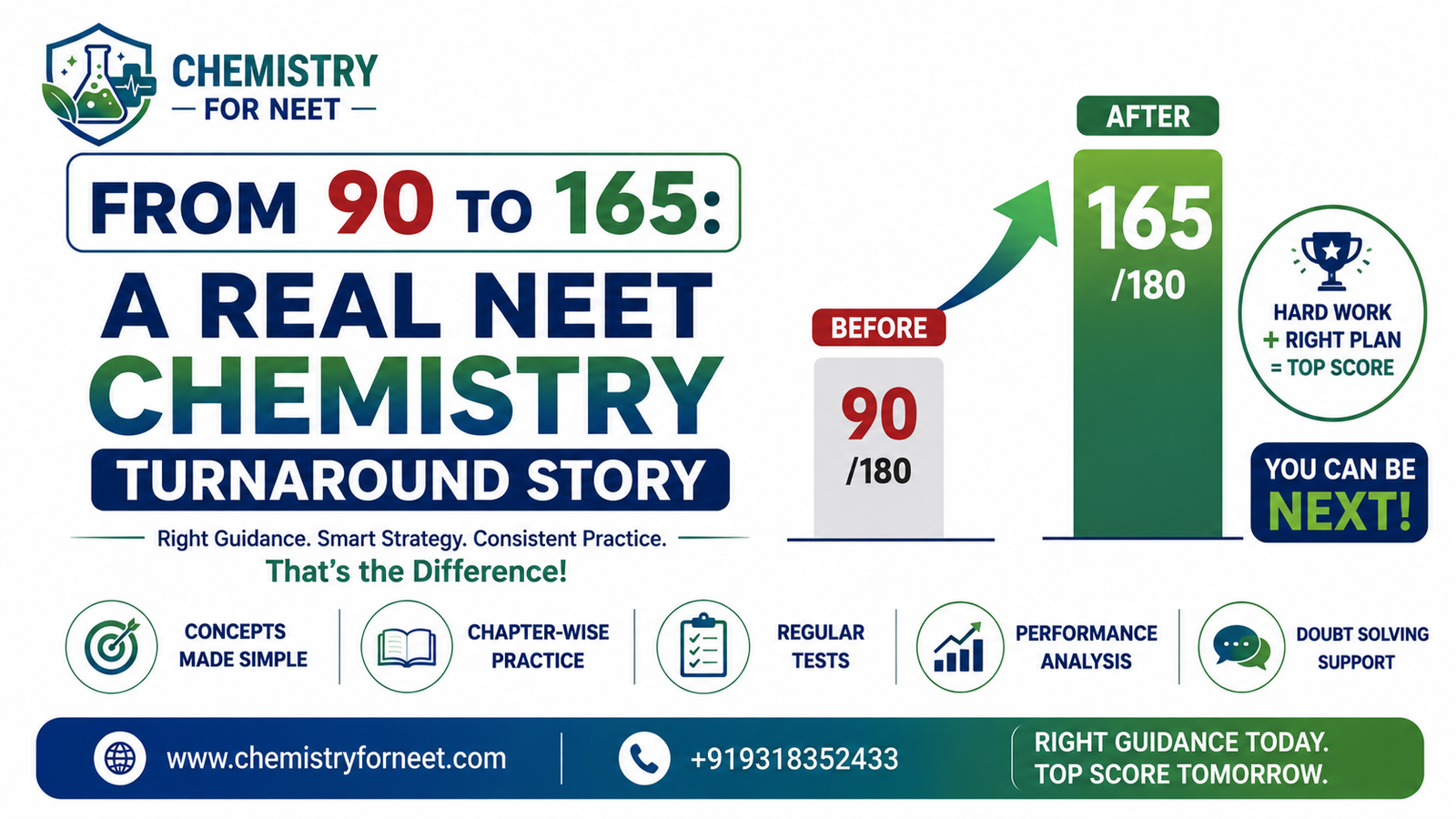
Table of Contents
Six months before her NEET attempt, Riya scored 90 out of 180 in Chemistry on her first proper mock test. Six months later, on the actual exam, she scored 165. This is, in essence, the from 90 to 165 NEET Chemistry turnaround story I've been asked to write down properly for a while now. I want to be upfront about something before going any further: the name here is changed, and a few identifying details are adjusted, but the trajectory itself — the specific score, the specific timeline, the specific mistakes along the way — is drawn directly from students I've actually mentored through nearly this exact arc. I'm telling this story not because it's rare, but because it's closer to a repeatable pattern than most students realise when they're sitting at a 90 themselves, feeling like the gap to a competitive score is impossibly large.
This is a real neet chemistry success story in the sense that matters most — every strategy described actually happened, in roughly this sequence, and has produced this kind of result across dozens of students I've worked with, not just one. If you're looking for how to improve NEET Chemistry score starting from a similarly rough place, this article is really two things at once: Riya's specific neet chemistry preparation journey, and the general chemistry study plan for NEET underneath it that you can apply to your own preparation, regardless of your current starting score.
If you'd like this same structure taught to you directly rather than pieced together from an article, that's genuinely what my regular batches and crash course are built around — whether that's a full structured chemistry classes for NEET preparation programme or the best online chemistry teacher for NEET you can find working with you directly, week to week.
Where This Story Actually Starts: A Score of 90
A 90 in Chemistry isn't a disaster, but it isn't a launching pad either — it's roughly the point where a student has some scattered knowledge but no real system holding it together. When Riya first came to me, she could explain GOC reasonably well in isolation, but froze the moment a question combined it with something else. Her chemistry preparation from zero to advanced didn't actually need to start from zero at all — the bigger problem wasn't missing knowledge, it was knowledge that had never been organised into something usable under real time pressure. That distinction, between missing knowledge and disorganised knowledge, ended up shaping almost every decision we made over the following six months.
The Diagnosis That Actually Mattered
Her first real mock test told us more in three hours than a month of her own self-study had. Physical Chemistry accuracy was fine when untimed, but collapsed under a clock. Organic was inconsistent chapter to chapter, which usually means GOC itself was shakier than it looked on the surface. Inorganic was, ironically, her strongest section, purely because she'd leaned on memorisation there without realising how much luck that strategy actually depends on when a question doesn't match the exact phrasing she'd memorised. None of this was visible from her own self-assessment beforehand — she genuinely believed Inorganic was her weakest section, when the actual test data said the opposite.
What Actually Changed First
Before any specific chapter got touched, two things had to change about how Riya was approaching preparation itself, and neither of them involved studying more hours than she already was.
Concept Based Chemistry Learning for NEET, Not More Hours
The first change wasn't more study time — Riya was already putting in reasonable hours. It was changing what those hours were actually spent on. We stopped rereading chapters and started rebuilding GOC and Physical Chemistry fundamentals from the actual logic underneath them, slower at first, with the explicit understanding that speed would come later, once the foundation stopped needing conscious effort to recall under pressure. This felt, for the first couple of weeks, like moving backwards rather than forwards, which is a genuinely uncomfortable feeling for a student already worried about lost time.
Accepting a Temporary Score Plateau
For close to three weeks, her mock scores didn't move, and in one case dipped slightly. This is genuinely normal, and it's also the point most students quit a new strategy, assuming it isn't working. The plateau is usually where old, fragile knowledge is being replaced with something more durable, and the payoff shows up a few weeks later, once that quiet rebuilding is actually complete. I remember this specific stretch being the hardest part of the whole six months for Riya, purely psychologically, even though it turned out to be the most important part in hindsight.
Pro Tip from S.K. Sir:
If a genuinely new strategy hasn't moved your score within three weeks, that's not automatically failure — it's often the point right before movement actually starts. Give a real change at least a month before judging whether it's working, and resist the urge to abandon it purely because the discomfort of a flat score feels worse than the discomfort of staying with a familiar, if less effective, routine.
The Strategy, Subject by Subject
Once the foundation was actually being rebuilt properly, the neet chemistry improvement strategy split into distinct approaches for each section, because Physical, Organic, and Inorganic simply don't respond to the same kind of effort. The chemistry revision strategy for NEET that eventually emerged looked quite different by month five than it had in month one, and that evolution was deliberate, not accidental — each phase was built specifically to address whatever the previous month's mock tests had actually revealed, rather than following a fixed plan set in stone from day one.
Physical Chemistry Strategy for NEET: Speed Over Precision
Riya's Physical Chemistry problem was never conceptual understanding — it was that she calculated with full precision every single time, which is far too slow for a 60-second question. We spent two focused weeks purely on approximation and rounding habits, treating speed as a skill worth practising directly rather than something that would simply arrive with more practice over time. By the end of those two weeks, the same numericals that used to take her ninety seconds were taking closer to forty, without any loss in accuracy.
Organic Chemistry Strategy for NEET: GOC First, Then Everything Else
Every inconsistent Organic answer traced back to the same root cause once we actually looked closely: GOC that was solid enough for a straightforward question but fell apart the moment a question combined two concepts. Rebuilding GOC from first principles, slowly, fixed problems in Aldehydes, Amines, and Haloalkanes that looked, on the surface, like separate issues in three different chapters, but were really the same underlying gap showing up in three different disguises.
Inorganic Chemistry Strategy for NEET: Five Chapters, Not Twenty
Rather than spreading revision evenly across the entire Inorganic syllabus, we narrowed focus to Chemical Bonding, Periodicity, the p-Block, the d- and f-Block, and Coordination Compounds — the five chapters that actually carry the bulk of the section's weightage. Riya's existing memorisation-heavy approach got layered with real understanding of these five specifically, which made her already-decent Inorganic score noticeably more reliable rather than dependent on lucky phrasing matching what she'd happened to memorise.
Chemistry Mock Test Strategy, Error Analysis, and Time Management
From month three onward, a proper chemistry mock test strategy for NEET took over as the backbone of preparation: a full-length mock every week, followed by genuine chemistry error analysis for NEET within 48 hours, logging exactly why each mistake happened rather than just noting the wrong answer. Chemistry time management for NEET improved almost as a side effect of this process, once we could see precisely which chapters were eating disproportionate time inside a full paper. Working through chemistry previous year questions for NEET chapter by chapter, alongside the weekly mocks, rounded out the routine for the final three months, giving her a genuinely comprehensive final stretch rather than one built around a single method alone.
The Numbers: How the Score Actually Moved
Score improvement rarely looks like a smooth, upward line, and Riya's didn't either. Month one held flat around 90, through the deliberate foundation rebuild described above. Month two moved to roughly 110, mostly from Physical Chemistry speed improvements starting to show up under timed conditions, once the approximation habits from those two focused weeks had genuinely settled in. Months three and four pushed into the 125 to 140 range, as Organic Chemistry consistency caught up with the GOC rebuild finally paying off across multiple chapters at once, rather than showing up in just one.
The final two months were where things genuinely accelerated, moving from the 140s into the 160s, largely on the back of the weekly mock and error-analysis cycle catching and closing smaller gaps before they could cost real marks. Her actual NEET Chemistry score of 165 was, by that point, entirely consistent with where her last month of mock tests had already settled — which is really the whole point of how to score 160+ in NEET Chemistry done properly: the real exam score shouldn't be a surprise by the time you actually sit it.
It's worth being honest that this timeline wasn't perfectly linear even within each month. There were individual mocks that dipped below the general trend, usually right after a particularly demanding week at school, and at least one test where a careless mistake on an easy chapter cost more marks than any genuine gap did. What mattered more than any single test was the trend line across four consecutive tests, which is the same principle I'd encourage any student to apply to their own results rather than reacting to one test in isolation.
What This Story Actually Means for Your Preparation
I'm wary of turning one story into a universal promise, so let me be precise about what actually transfers here. The specific number, 90 to 165, won't apply identically to every student — some start lower, some higher, some have less time than Riya's six months. What does transfer is the underlying chemistry topper strategy for NEET: diagnose honestly before planning, rebuild foundations even when it costs a temporary plateau, split strategy by subject rather than treating Chemistry as one uniform block, and let weekly testing and real error analysis drive the final stretch.
None of these four elements are individually surprising or clever. What made the difference for Riya wasn't discovering some hidden trick nobody else knew about — it was actually following through on advice that's genuinely available to any NEET aspirant, consistently, for six straight months, without abandoning it during the uncomfortable plateau in the middle. That consistency is the part almost nobody wants to hear, because it's less exciting than a secret method, but it's the actual mechanism behind almost every genuine turnaround story I've been part of.
Whether you're building a chemistry roadmap for NEET 2026 with limited time left or a chemistry roadmap for NEET 2027 with more room to work in, this sequence doesn't change, only the pace does. Stories like Riya's aren't really about neet chemistry motivation and success in some vague, inspirational sense — they're evidence that a specific, unglamorous process, followed consistently for six months, produces results that look dramatic from the outside but were entirely predictable from the inside, one weekly test at a time.
Frequently Asked Questions
Is a jump from 90 to 165 realistic for most students, or is this an unusual case?
It's an ambitious but genuinely achievable outcome for a student starting around that range, provided the six months are used with real discipline. It isn't guaranteed for everyone, since consistency and how quickly foundational gaps close both matter, but it's common enough among students who actually follow a structured plan that I wouldn't call it exceptional, even if it feels that way from the outside looking in.
How do I increase chemistry marks in NEET if I'm starting even lower than 90?
The same underlying process applies, just with more time needed for the foundational rebuild before the mock-test phase can begin properly. A student starting at 60 or 70 typically needs the first phase to run somewhat longer than Riya's did, since there's genuinely more foundational work to do before testing becomes the most useful activity to focus on.
What was the single biggest factor in this chemistry score improvement for NEET?
If I had to pick one, it would be the willingness to tolerate a temporary plateau rather than abandoning the new approach after two weeks. Most students who don't see this kind of turnaround aren't lacking a good strategy — they switch strategies too early, right before the one they were trying would have paid off, and end up cycling through several half-finished approaches instead of seeing one through.
Did this student have any prior advantage, like extra tutoring or a strong school background?
No more than an average NEET aspirant. The turnaround came from the specific sequence and consistency described in this article, not from any unusual prior preparation or resources unavailable to most students preparing for NEET through a normal school and coaching background.
How long before I'd know if this kind of strategy is actually working for me?
Give it a genuine month before drawing conclusions, in line with the plateau described earlier in this story. Weekly mock test trends across that first month, not any single test in isolation, are the clearest early signal of whether the approach is taking hold or needs adjusting.
Can I follow this same strategy without a chemistry mentor for NEET aspirants guiding me?
Parts of it, yes, particularly the mock test and error analysis routine. The harder part to replicate alone is the honest initial diagnosis and the discipline to keep rebuilding a foundation during a plateau instead of second-guessing the plan — that's usually where structured chemistry coaching for NEET adds the most genuine value, precisely at the point self-doubt is highest.
Want This Same Turnaround, Guided Directly?
Every part of Riya's process in this article is something I can walk through with you personally, starting with an honest diagnosis of where your own Chemistry preparation actually stands today, not where you assume it stands. If you're looking for the best chemistry teacher for NEET or top chemistry teacher for NEET in India to guide your own version of this story, I'd be glad to have you in the next batch and see where your own six months could actually take you.
Book a Free Demo Class