How S.K. Sir Recommends You Study Chemistry for NEET 2027
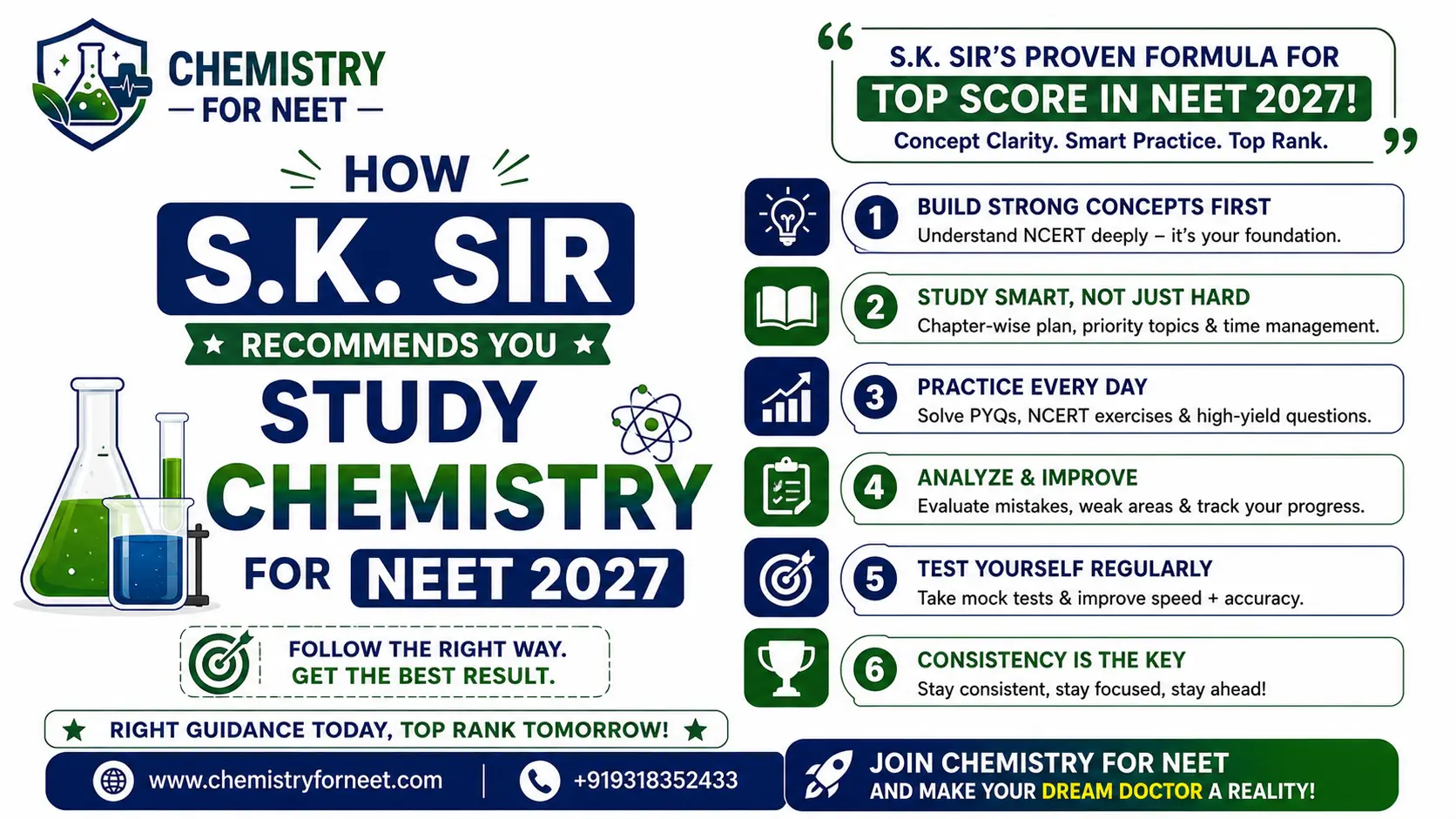
Table of Contents
- Why "How You Study" Beats "What You Study"
- How to Structure a Single Study Session
- Note-Making That Actually Gets Used Again
- Studying Each Section Differently
- How to Handle Doubts and Find Hidden Gaps
- Revision, PYQs, and Testing as Study Methods
- Building a Weekly Rhythm You Can Sustain
- Study Habits That Feel Productive but Aren't
- Why This Guidance Comes From S.K. Sir
- Frequently Asked Questions
Almost every NEET 2027 chemistry preparation strategy you'll find online tells you what to study and when — which chapters, in which order, across how many months. Far fewer tell you how to actually sit down and study a chapter properly once you've decided to. That second question is, in my experience, where most students genuinely lose ground, and it's what this article is entirely about. Two students can follow an identical neet chemistry study plan 2027, put in identical hours, and end up thirty marks apart, purely because of what actually happens inside those hours. So this is how S.K. Sir recommends you study Chemistry for NEET 2027 — the methods, not the schedule.
I've written separately about the full NEET 2027 Chemistry roadmap — the phases, the sequencing, the timeline, and the broader question of how to prepare Chemistry for NEET 2027 across a full year. This article deliberately doesn't repeat that neet chemistry roadmap 2027. Instead, it covers the actual study methods underneath it: how to structure a single session, how to make notes you'll genuinely use again, how to handle doubts, and which common habits quietly waste months of otherwise honest effort. Consider this the practical companion to the roadmap rather than a second version of it.
Everything here comes from watching students study, closely, for 18 years, and noticing which methods actually produce retention and which ones only produce the feeling of productivity. That distinction matters more than almost anything else in the best way to study chemistry for NEET, and it's the thread running through every section that follows. If there's a single neet chemistry success strategy underneath all of this, it's simply that method quality compounds over a long preparation window in a way that extra hours alone never quite do.
Why "How You Study" Beats "What You Study"
A good roadmap tells you the right chapters in the right order. It says nothing about whether the hours you spend on those chapters actually produce durable understanding, and that's where the real variance between students lives.
Passive Reading Feels Like Studying, and Mostly Isn't
Reading a chapter, highlighting it, and reading it again produces a strong feeling of familiarity that's very easy to mistake for actual knowledge. The uncomfortable test is simple: close the book and try to explain the concept aloud. Most students who've spent three hours reading discover they can't do this, and that gap between recognition and recall is precisely what a NEET question is built to expose.
Active Recall Is Uncomfortable, Which Is Why It Works
Genuine concept based chemistry preparation for NEET is built on retrieval, not review. Every time you force yourself to recall something without looking, you strengthen it far more than another pass of reading ever would. It feels harder and slower, and students often resist it for exactly that reason, but the discomfort is the mechanism, not a sign that something's going wrong.
Hours Studied Is the Wrong Metric
Tracking hours encourages students to optimise for time spent at a desk rather than material genuinely mastered. A far better daily question is: what could I explain today that I couldn't explain yesterday? A student who answers that honestly, every day, will outperform one who logs more hours without ever asking it.
Pro Tip from S.K. Sir:
At the end of every study session, close everything and write down, from memory, the three most important things from what you just studied. If you can't produce three, you didn't study it — you read it. This takes two minutes and changes what the previous hour was actually worth.
How to Structure a Single Study Session
This is the sequence I'd genuinely recommend for a single Chemistry session, whether it's ninety minutes or three hours, and it applies at every stage of NEET 2027 chemistry preparation.
Start With Five Minutes of Recall, Not New Material
Before opening anything new, spend five minutes recalling what you studied in the previous session, from memory. This does two things at once: it strengthens the older material through retrieval, and it warms you into the subject far more effectively than diving straight into an unfamiliar chapter cold. Students consistently underestimate how much of the previous session has already faded within twenty-four hours, and these five minutes surface that decay before it compounds across a week.
Learn in Small Blocks, Test Immediately
Rather than reading an entire chapter then attempting questions, break it into smaller conceptual blocks and attempt two or three questions after each one. This surfaces misunderstandings within minutes rather than hours, while the explanation is still fresh enough to correct efficiently. The alternative — reading forty pages then discovering a misunderstanding from page four has quietly corrupted your understanding of everything after it — costs far more time to unpick than the interleaved approach ever does.
End With a Written Summary From Memory
Close every session by writing a short summary of what you covered, without looking at your notes or the textbook. This is the single highest-value ten minutes in any study session, because it forces retrieval at exactly the point most students would otherwise simply close the book and move on, leaving the material far more fragile than it feels. It also produces, almost as a side effect, a genuinely useful revision document written in your own words.
Keep Sessions Single-Subject, Not Mixed
Switching between Chemistry and another subject mid-session costs more than most students realise, since re-entering a subject takes real mental effort each time. Protect Chemistry sessions as genuinely single-subject blocks. Alternating between Physical, Organic, and Inorganic within a Chemistry session is fine and often useful — switching to Biology halfway through is not the same thing at all.
Note-Making That Actually Gets Used Again
Most students make notes they never open again, which makes note-making an expensive habit with no return. Here's how to make notes that genuinely earn the time they cost.
Write Notes for Your Future Self, Not as a Transcript
Copying a textbook into a notebook is transcription, not note-making, and it produces documents nobody wants to revise from. Good notes are shorter than the source, organised around your own understanding, and specifically capture what you personally found difficult — because that's what future-you will actually need reminding of.
Three Notebooks, Not One
I recommend keeping three separate notebooks: one for formulas with their exact conditions, one for reaction mechanisms and their identifying features, and one for exceptions and anomalies that don't follow the general rules. Mixing all three together produces a document that's hard to revise from quickly, precisely when speed matters most.
Revisit and Prune, Don't Just Add
Notes should shrink over time, not grow indefinitely. Once something is genuinely mastered, it can come out of your active revision notes entirely. A student in the final phase should be revising from something dramatically shorter than what they wrote a year earlier, and that shrinkage is itself a useful measure of real progress. Notes that only ever grow are a sign that nothing is being genuinely retained, just accumulated.
Studying Each Section Differently
Physical, Organic, and Inorganic Chemistry reward genuinely different study methods, and using one uniform approach across all three is among the most common reasons students plateau despite honest effort. This is worth being deliberate about, because the default is to study everything the same way without ever consciously deciding to.
Physical Chemistry: Study by Solving, Not by Reading
A sound physical chemistry strategy for NEET 2027 means most of your study time here is spent with a pen actually moving, solving problems, rather than reading theory. Read a concept once, then learn it through application. Physical Chemistry is a doing subject, and treating it as a reading subject is why so many students understand it and still can't solve it quickly under a clock.
Organic Chemistry: Study by Predicting
An effective organic chemistry strategy for NEET 2027 is built around prediction. Cover the product, look at the reactants and reagent, and predict what forms before checking. This trains the exact skill NEET tests, rather than the recognition memory that reading reaction sequences builds instead. A student who's only ever read mechanisms will recognise them; a student who's predicted them will be able to handle an unfamiliar substrate.
Inorganic Chemistry: Study by Grouping
A good inorganic chemistry strategy for NEET 2027 means organising facts into patterns rather than memorising them as isolated items. Study properties across a group together, so the underlying trend becomes visible and the individual facts start reinforcing each other rather than competing for memory independently. Twenty facts organised around one trend are far easier to retain than twenty facts memorised separately.
How to Handle Doubts and Find Hidden Gaps
The doubts you know about are rarely the dangerous ones. The gaps that actually cost marks are usually the ones a student doesn't yet know exist.
Write Doubts Down Immediately, Resolve Them Within 48 Hours
An unresolved doubt doesn't stay contained — it quietly undermines every later topic that depends on it. Keep a running doubt list, and treat 48 hours as the maximum acceptable delay before resolving each one, whether through a teacher, a classmate, or genuinely careful independent work.
Use the Explain-It-Aloud Test to Find Unknown Gaps
Try explaining a chapter aloud, as though teaching it to someone who's never seen it. The exact point where your explanation becomes vague or you start reaching for phrases you can't unpack is a gap you didn't know you had. This is the fastest self-diagnostic I know of, and it costs nothing but a few minutes of mild discomfort.
Distinguish "I Forgot" From "I Never Understood"
These two look identical when you get a question wrong, and they need completely different responses. A forgotten fact needs revision and spacing. A concept never properly understood needs re-teaching from the beginning, and no amount of revision will fix it, because there's nothing solid there to refresh. Asking yourself which of the two you're dealing with, every time you get something wrong, prevents months of revising material that was never actually learned in the first place.
Revision, PYQs, and Testing as Study Methods
Revision and testing aren't separate from studying — done properly, they're among the most efficient forms of studying available, which is exactly why a neet chemistry revision strategy 2027 should start far earlier than most students assume.
Spaced Revision Beats Massed Revision
Revisiting a chapter briefly at increasing intervals — a few days later, then a couple of weeks, then a month — produces dramatically better retention than one long revision session, even when the total time spent is identical. Build this spacing into your schedule deliberately rather than revising whatever feels most urgent that week.
Treat PYQs as Study Material, Not Just Assessment
Chemistry pyq practice for NEET 2027 works best when previous year questions are used to learn from, not merely to score yourself against. Working through previous year questions chapter by chapter teaches you how the NTA actually phrases a concept, which is genuinely different information from what a textbook provides.
Mock Tests Are Diagnostic Tools First
A sound neet chemistry mock test strategy treats the score as the least interesting output. What matters is the analysis afterward: which specific chapters cost time, which mistakes were conceptual versus careless, and which gaps keep recurring across multiple tests rather than appearing once. A test you don't analyse properly taught you almost nothing beyond a number, and that number was never the point.
Building a Weekly Rhythm You Can Sustain
Here's a chemistry study timetable for NEET 2027 built around study methods rather than syllabus coverage, since the coverage plan is covered in the roadmap article linked earlier. The point of a rhythm, rather than a rigid schedule, is that it survives a bad week without collapsing entirely.
- Daily, 90 minutes minimum: Opening with five minutes of recall, then new material in small blocks with immediate practice, closing with a written summary from memory.
- Daily, 15 problems minimum: Weighted toward whichever section is currently weakest, not whichever feels most comfortable to practise.
- Weekly, one spaced-revision session: Covering material from three to four weeks ago specifically, not just last week's chapter.
- Weekly, one doubt-clearing block: Working through the running doubt list rather than letting items accumulate indefinitely.
- Weekly, one chapter-wise PYQ session: Treated as learning material, with each question's reasoning understood rather than just marked right or wrong.
- One genuine rest day: Fully off, without guilt, because sustaining this rhythm over a year requires actual recovery built in.
The value here isn't in any single item — it's in the fact that each one is a method, not just a time slot. A timetable that only specifies when you'll study, without specifying how, leaves the most important variable entirely unaddressed, which is precisely why so many carefully built schedules produce disappointing results.
Study Habits That Feel Productive but Aren't
These are the specific habits I most often have to talk students out of, precisely because each one genuinely feels like effective studying while it's happening. That's what makes them dangerous — an obviously lazy habit gets corrected quickly, while a habit that feels diligent can persist for months without anyone questioning it.
Highlighting Instead of Retrieving
Highlighting produces a colourful page and very little retention. If you highlight, follow it immediately with a closed-book attempt to recall what you highlighted, or the activity does almost nothing beyond marking the page.
Collecting Resources Instead of Using One
Downloading five sets of notes, three question banks, and multiple video series feels like progress, but choosing between resources consumes time that studying any single one of them properly would have used better. Pick a small set and go deep rather than broad.
Re-Studying Strong Chapters Because They Feel Good
Revising a chapter you're already strong in is genuinely pleasant, and that's exactly why students drift toward it. Real progress comes disproportionately from the chapters that feel uncomfortable, which is precisely the material most likely to get quietly avoided week after week.
Waiting to "Start Properly" Once Basics Are Revised
Plenty of students postpone real preparation until they've "gone back over the basics first," which frequently becomes an indefinite delay. Chemistry preparation from basics for NEET 2027 is genuinely important, but it happens best inside active study, not as a separate preliminary phase you complete before the real work begins. Start the actual chapters and repair foundations as specific gaps surface, rather than waiting for a readiness that never quite arrives.
Why This Guidance Comes From S.K. Sir
Study-method advice is easy to write and hard to verify, so it's worth being clear about where this particular set of recommendations actually comes from rather than leaving it assumed. If you've landed here searching for how SK Sir recommends you study Chemistry for NEET 2027 specifically, rather than a generic study-tips article, this section explains why the advice above takes the shape it does.
The S.K. Sir chemistry strategy for NEET 2027 described throughout this article isn't assembled from general study-skills research applied loosely to Chemistry. It comes from 18 years of watching students study this specific subject, closely enough to notice which methods produced durable retention months later and which produced confident-looking students who struggled on unfamiliar questions. S.K. Sir NEET chemistry preparation has always treated method as seriously as content, because the same syllabus studied two different ways produces genuinely different outcomes.
Whether you're searching for the best chemistry teacher for NEET 2027, the top chemistry teacher for NEET 2027 in your own city, the best chemistry teacher for NEET in India more broadly, or simply top chemistry faculty for NEET 2027 who'll take your study method seriously rather than just your syllabus coverage, I'd suggest judging any of them against what's actually in this article. Good chemistry preparation guidance for NEET should be specific enough to disagree with, not vague enough to be unfalsifiable.
Frequently Asked Questions
How many hours a day should I study Chemistry for NEET 2027?
Around 90 minutes to two hours daily is a reasonable target, though I'd genuinely encourage you to stop tracking hours as your primary measure. What you can explain from memory at the end of a session tells you far more about whether that session worked than the clock does, and optimising for the clock tends to quietly degrade the quality of what happens inside it.
Should I make my own notes if I already have coaching notes?
Yes, but not as a duplicate. Coaching notes cover the syllabus; your own notes should capture specifically what you found difficult, which is different for every student and is exactly what makes personal notes worth the time they cost. If your notes look substantially like your coaching material, you've transcribed rather than processed it.
Is it better to finish a chapter fully before starting questions?
No, and this is one of the more common mistakes. Attempting questions after each small conceptual block surfaces misunderstandings early, while reading an entire chapter first tends to let several misunderstandings accumulate before any of them get caught, which is considerably more expensive to untangle afterward.
How do I know if my study method is actually working?
The explain-it-aloud test is the fastest check available. If you can teach a chapter clearly, without notes, to an imaginary beginner, your method is working. If you can only recognise material when you see it, something needs to change regardless of how many hours went into it or how confident the material felt while reading.
Does this approach change if I'm studying with an online chemistry teacher for NEET 2027?
The methods don't change at all — they're about what you do between classes, which matters regardless of format. What good chemistry coaching for NEET 2027 adds is faster doubt resolution and someone checking whether your self-assessment is actually accurate, which is genuinely difficult to do for yourself.
I've been studying for months but scores aren't moving. What should I change first?
Change the method before adding hours. Most stalled students are reading and re-reading rather than retrieving. Switching to closed-book recall and immediate practice usually shows a difference within a few weeks, without any increase in time spent studying at all, which is why method is always the first thing worth examining.
How to score high in NEET Chemistry 2027 if I have limited daily study time?
Limited time makes method quality more important, not less. A focused 90 minutes using active recall and immediate practice genuinely outperforms four unfocused hours of reading, so protect the quality of your sessions before worrying about extending their length. Students with less available time often end up with better methods precisely because they can't afford inefficient ones.
Want Someone Checking Whether Your Method Is Actually Working?
The hardest part of everything in this article is judging your own progress honestly, since the feeling of understanding is genuinely unreliable. If you'd like a chemistry mentor for NEET 2027 who'll actually test that for you rather than take your word for it, whether through structured chemistry classes for NEET 2027 or working with the best chemistry tutor for NEET 2027 you can find, a free demo class is the easiest place to start.
Book a Free Demo Class