Inorganic Chemistry for NEET: The Chapters That Decide Your Score
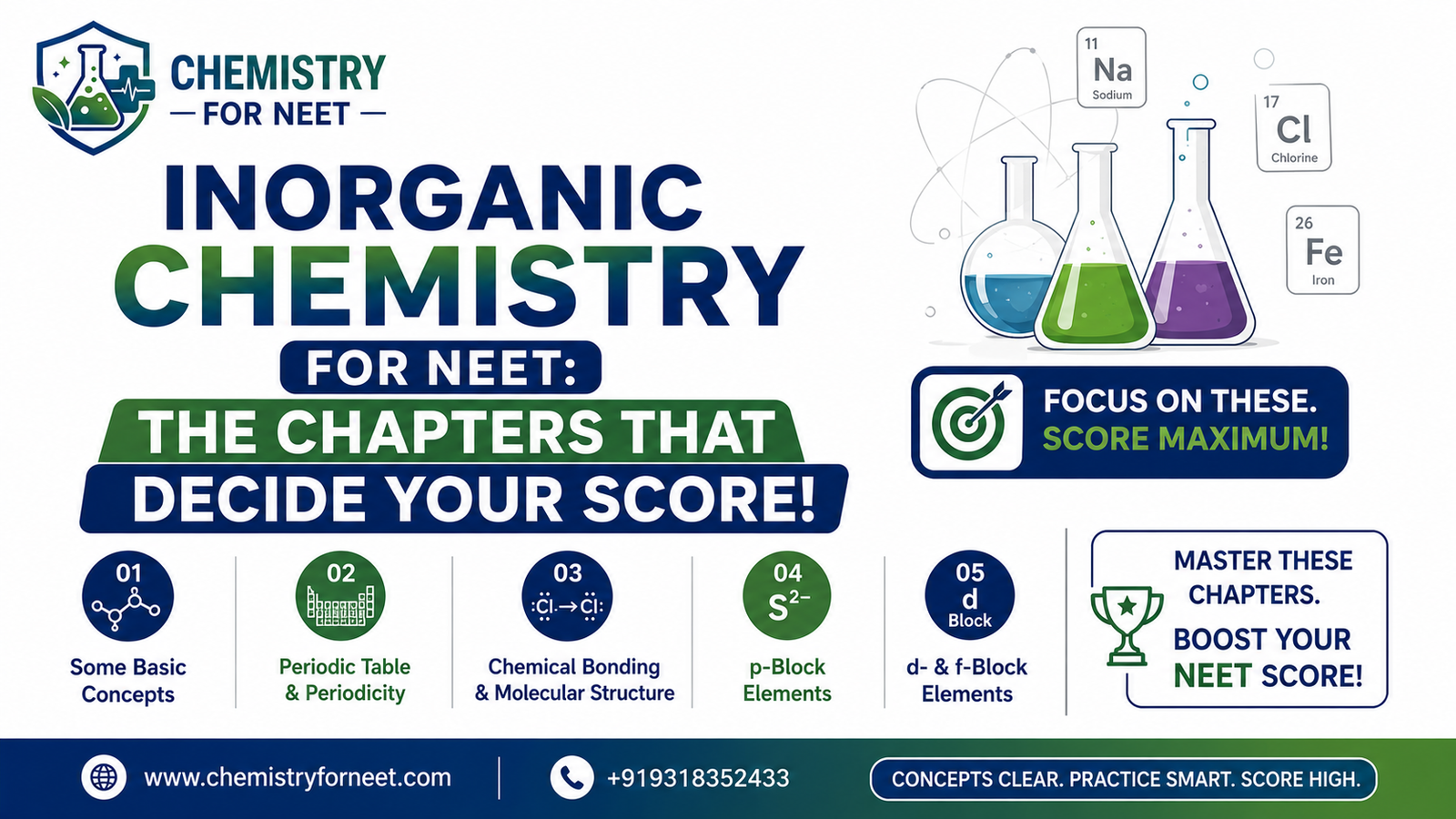
Table of Contents
Inorganic Chemistry has an image problem. Ask most NEET aspirants what they think of it, and you'll hear some version of "the memorisation subject" — the one you cram in the final week and hope holds together on exam day. That reputation is largely undeserved, and it's also expensive, because treating all of inorganic chemistry for NEET as equally forgettable means missing the handful of inorganic chemistry chapters that decide your score, one way or the other. After 18 years of teaching this subject, I can tell you five important inorganic chemistry chapters for NEET specifically carry a disproportionate share of the marks, and none of them are optional.
This isn't a generic list of neet chemistry important chapters pulled from a syllabus index. Based on our own inorganic chemistry chapter wise weightage for NEET analysis, these five chapters — Chemical Bonding, Periodicity, the p-Block, the d- and f-Block, and Coordination Compounds — make up the overwhelming majority of the actual chemistry chapter weightage for NEET inside the Inorganic section. Get these five genuinely solid, and the rest of Inorganic Chemistry becomes far easier to hold together, because most of it borrows logic from these same five chapters anyway. This is really how to score high in Inorganic Chemistry for NEET, in one sentence: prioritise these five, properly, before anything else, as part of a genuine inorganic chemistry strategy for NEET rather than an even spread across the whole syllabus that treats a two-page chapter the same as a twenty-page one.
Whether you're doing neet chemistry 2026 preparation with a few months left or neet chemistry 2027 preparation with more runway to work with, the chapters below don't change. What changes is how much time you can afford to spend building the foundation properly versus compressing it into rapid revision closer to the exam, and how urgently your inorganic chemistry preparation for NEET needs to shift toward these top inorganic chemistry topics for NEET specifically. A student six months out can afford to build each chapter slowly, from first principles. A student six weeks out needs to move straight to the high-yield core of each one, skipping the slower foundational build-up this article otherwise recommends.
1. Chemical Bonding and Molecular Structure: The Root of Everything Inorganic
If Inorganic Chemistry had a single chapter every other chapter secretly depends on, this would be it, and treating it as just another chapter to get through is one of the more expensive mistakes students make early in their preparation.
Why Nothing Else in Inorganic Makes Sense Without This
Hybridisation, VSEPR theory, and Molecular Orbital Theory don't just belong to this one chapter — they quietly explain why p-Block compounds have the shapes they do, why d-Block complexes behave the way they behave, and why certain bonds are stronger than others across the entire syllabus. Students who skim Chemical Bonding to get to "easier" factual chapters end up re-learning the same logic from scratch, piecemeal, in every chapter that follows it, which is a slower and more frustrating way to arrive at the same understanding.
The NCERT Detail Students Skip
A lot of ncert inorganic chemistry for NEET content in this chapter sits in exceptions rather than the main rules — why certain molecules don't follow expected geometry, why some bonds have more ionic character than their electronegativity difference alone would suggest. These exceptions show up in NEET questions specifically because they're the parts most students skip on a first read through the chapter, assuming the main rules are all that's actually being tested.
Pro Tip from S.K. Sir:
Before moving past Chemical Bonding, test yourself on five molecules that don't follow "expected" geometry. If you can explain each exception, not just recall it, you're actually ready to move on to the p-Block, where this logic gets applied constantly, chapter after chapter, for the rest of Inorganic Chemistry.
2. Classification of Elements and Periodicity: The Pattern Behind Every Trend
This chapter is where inorganic chemistry from basics for NEET actually starts, and treating it as a warm-up chapter to rush through is a mistake that costs marks in every chapter that follows it later in the syllabus.
Trends Are Rarely the Actual Question
NEET rarely asks a direct "which element has higher electronegativity" question, because that's too predictable to differentiate students. What actually gets asked, consistently, are the exceptions to standard periodic trends — and those exceptions only make sense once the underlying trend itself is genuinely understood, not just memorised as a direction on a chart pinned above a desk. A student who can explain why an exception happens, rather than just that it happens, is noticeably better prepared for how NEET actually phrases these questions.
Building a Reference You'll Actually Use Later
Every later inorganic chapter assumes fluency with periodic trends. Building a clear reference here, ionic radius, ionisation enthalpy, electron gain enthalpy, electronegativity, each with its trend and its major exceptions, pays off directly when the p-Block and d-Block chapters start leaning on the same underlying logic, chapter after chapter, without re-explaining it from scratch each time.
3. p-Block Elements
The p-Block spans six groups and a genuinely large volume of factual content, which is exactly why it gets treated as a memorisation chapter more than any other part of Inorganic Chemistry, often unfairly. Students who approach it group by group, in isolation, tend to find it exhausting in a way that's largely avoidable with the right underlying approach.
Why This Chapter Is Actually About Patterns, Not Facts
Properties across a p-Block group follow the same underlying logic as the periodicity chapter that came before it — the facts aren't random, they're the periodicity trends applied to six specific groups. Students who've genuinely internalised Periodicity find the p-Block noticeably easier to hold onto than students who tried to memorise each group's properties independently, group by group, without connecting them back to the trends that actually explain them.
The Anomalous Behaviour Questions NEET Keeps Asking
The first element in several p-Block groups behaves differently from the rest of its group, and NEET tests this anomalous behaviour specifically, repeatedly, across different years. This is one of the higher-yield, more predictable question types in the entire chapter, and it's worth dedicated attention rather than getting lost inside the broader chapter's sheer volume of content, which can otherwise feel overwhelming without a clear sense of where to focus first.
4. d- and f-Block Elements
This chapter genuinely does require more factual retention than most others, but treating it as pure memorisation still leaves marks on the table that a bit of underlying logic would recover fairly easily, often without much extra study time invested beyond what you'd spend memorising anyway.
Why Transition Metals Behave the Way They Do
Variable oxidation states, colour, and catalytic behaviour in transition metals all trace back to partially filled d-orbitals, which is the same underlying concept explaining three seemingly unrelated properties at once. Learn that one connection properly, and three separate "facts" become one idea applied three times, rather than three things to memorise independently, which is a far more efficient way to hold onto this chapter under exam pressure months from now.
What's Actually Worth Memorising Here
Specific colours of common ions, standard oxidation states, and a handful of named compounds are worth committing to memory directly, since there's no deeper logic that reliably predicts them. Being honest about which parts of a chapter need memorisation and which need understanding is itself a useful study skill this chapter forces you to actually practise, and it's a skill that transfers directly to how you approach the p-Block and Coordination Compounds as well.
5. Coordination Compounds
If I had to recommend one inorganic chapter to master above all others, purely on time invested versus marks earned, this would be it, without much competition from anywhere else in the syllabus. It's also, encouragingly, one of the more self-contained chapters, which makes it a genuinely good place to build early confidence if the rest of Inorganic Chemistry still feels overwhelming.
Why This Chapter Is So Reliably High-Yield
Questions here circle back, year after year, to Crystal Field Splitting Energy, the magnetic properties of complexes, and the several types of isomerism specific to coordination compounds. Unlike broader chapters like the p-Block, Coordination Compounds is fairly self-contained, which makes it genuinely masterable in a focused window of a few days rather than weeks, especially once Chemical Bonding is already solid enough to lean on.
The Concept That Unlocks Most of the Chapter
Crystal Field Theory, once actually understood rather than memorised as a set of rules, explains colour, magnetism, and stability across the entire chapter in one framework. Students who learn CFT properly tend to find the rest of Coordination Compounds falls into place almost automatically, rather than needing to be separately memorised topic by topic across the chapter, which is exactly the kind of leverage that makes this chapter worth prioritising so heavily.
Turning These Five Chapters Into an Actual Study Plan
Knowing which five chapters matter most is only useful if it actually changes how you study, week to week, rather than staying as a list you agree with in theory but don't act on when it's time to actually sit down and revise.
An Inorganic Chemistry Study Plan for NEET That Respects Weightage
Spend roughly proportional time on each chapter's actual weightage, not equal time across all five. Coordination Compounds and Chemical Bonding deserve more concentrated attention than their page count in NCERT might suggest, precisely because of how consistently NEET tests them relative to their length. A student who splits time evenly across all five chapters, purely because that feels fair, is quietly under-investing in the two that actually matter most.
Inorganic Chemistry Tricks That Actually Hold Up
Most so-called inorganic chemistry tricks for NEET are really just memory aids for the memorisation-heavy parts. Mnemonics for group trends and colour sequences genuinely help, but they work best layered on top of real conceptual understanding, not as a replacement for it. A trick without the underlying logic tends to fail exactly when a question is phrased slightly differently than the version the trick was built around, which happens more often than most students expect once they're actually sitting the real exam.
Using PYQs and MCQs to Find Your Actual Gaps
Inorganic chemistry pyqs for NEET, worked through chapter by chapter, reveal patterns a textbook never will — which specific sub-topics NEET keeps returning to within each of these five chapters. Regular inorganic chemistry mcqs for NEET, used as inorganic chemistry question practice for NEET and filtered by chapter rather than solved randomly, is the fastest way to find out which of the five chapters actually needs more attention before your inorganic chemistry revision for NEET is genuinely complete. Our own inorganic chemistry notes for NEET are organised around this same five-chapter priority, for exactly this reason, and the same approach applies whether you're working through chemistry preparation for NEET inorganic section content alone or as part of structured inorganic chemistry coaching for NEET.
None of this needs to be complicated. Five chapters, studied in proportion to how much they actually matter, revised through real questions rather than passive re-reading, is a genuinely achievable plan for most students within the time they already have before NEET. The hard part was never knowing which chapters mattered — it's actually following through on that knowledge, week after week, until it becomes the way you naturally approach the rest of the syllabus too.
Frequently Asked Questions
Are these really the five chapters that decide an Inorganic Chemistry score, or just five examples?
These five specifically, based on how consistently they appear in NEET papers relative to the rest of the Inorganic syllabus. Other chapters matter too, but these five carry a disproportionate share of the actual marks relative to the study time they require, which is really the definition of a high weightage inorganic chemistry for NEET topic worth prioritising above the rest.
How much of my study time should Inorganic Chemistry actually get?
Roughly a third of your total Chemistry preparation time is a reasonable starting point, though the exact split depends on your own accuracy across Physical, Organic, and Inorganic specifically. If Inorganic is already a comparative strength, spend proportionally less time here and more where the gap is larger, rather than following a fixed split regardless of your actual performance.
Is Inorganic Chemistry easier to score in than Organic or Physical?
It can be, precisely because it's more predictable once these five chapters are genuinely solid. Physical Chemistry demands calculation speed and Organic demands mechanistic thinking, while Inorganic mostly rewards thorough, well-organised preparation, which is a more controllable variable than either of the other two, given enough consistent time invested properly.
Should I use NCERT alone, or do I need additional inorganic chemistry notes for NEET?
NCERT is the non-negotiable foundation, since the overwhelming majority of NEET Inorganic questions trace back to it directly. Additional notes are useful mainly for condensing the material for revision and highlighting exceptions, not for replacing NCERT as the primary source of truth for this section of the syllabus.
How do I know if I've actually mastered Coordination Compounds, or just recognise it?
Try explaining Crystal Field Theory to someone else without notes, specifically why a given complex is coloured or paramagnetic. If you can do that clearly, you've understood it. If you can only recall which answer matched which question from practice, that's recognition, not mastery, and it tends to fail on an unfamiliar question phrased just differently enough to matter.
Where do these five chapters fit into an overall inorganic chemistry roadmap for NEET?
They form the spine of it. Chemical Bonding and Periodicity come first, since everything else depends on them. The p-Block and d-/f-Block follow, applying that foundation to specific groups. Coordination Compounds comes last among these five, both because it's more self-contained and because it benefits from Chemical Bonding already being genuinely solid by the time you reach it.
Want These Five Chapters Actually Taught to You, Not Just Listed?
Reading about which chapters matter and actually mastering them under real exam conditions are two different things, and that gap is exactly where most students' Inorganic Chemistry preparation quietly stalls despite genuinely good intentions. If you'd like the top inorganic chemistry teacher in India you can find, the best inorganic chemistry teacher for NEET, the best inorganic chemistry mentor for NEET, or simply chemistry faculty for inorganic chemistry who'll walk through these five chapters with you directly, I'd be glad to have you in the next batch.
Book a Free Demo Class