Why Choose S.K. Sir for NEET 2027 Chemistry Preparation?
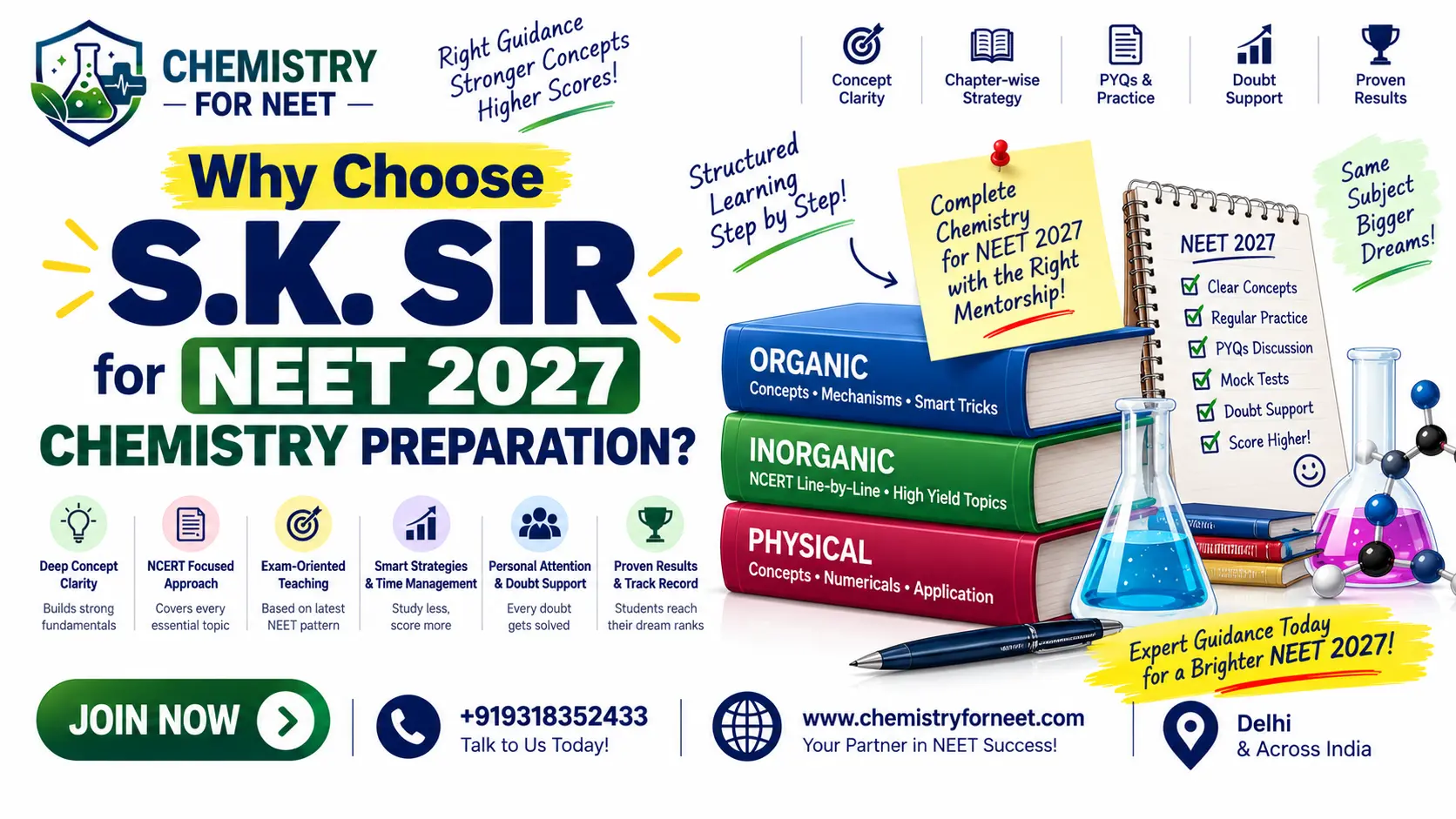
Table of Contents
- 1. Eighteen Years, Focused Specifically on NEET
- 2. Concept First, Across All Three Sections
- 3. Organic Chemistry Taught as Prediction, Not Memorisation
- 4. Inorganic Chemistry Taught as Patterns, Not Facts
- 5. Physical Chemistry Taught for Speed, Not Just Accuracy
- 6. A Mentor, Not Just a Teacher
- 7. A Structured Roadmap Built for NEET 2027 Specifically
- 8. Genuinely Live Online Classes
- 9. Small Batches and Results You Can Verify
- Frequently Asked Questions
Why choose S.K. Sir for NEET 2027 Chemistry preparation is a fair question to ask directly, and it deserves a direct answer rather than a page of adjectives. So here are nine specific, checkable reasons a sk sir chemistry teacher for NEET is worth considering, not nine ways of saying the same vague thing about passion and dedication. Some of these you can verify in a single phone call. Others you can only really judge by sitting through an actual class. I've tried to be clear about which is which.
If you'd rather read the fuller story behind these classes — the background, the philosophy, what an actual year of teaching looks like — that's covered in more depth in this earlier article. This one is deliberately more direct: nine reasons behind sk sir neet chemistry preparation, stated plainly, in the order I'd actually rank them if I were the one deciding.
A brief, honest note before the list: not every reason here will matter equally to every family. I'd encourage you to read all nine and weigh them against what your own child specifically needs, rather than treating neet 2027 chemistry preparation with expert guidance as a uniform argument that applies identically to everyone. If the question of why choose sk sir for neet 2027 chemistry preparation still feels open after reading all nine, a free demo class is the honest next step, not another article.
1. Eighteen Years, Focused Specifically on NEET
An experienced chemistry teacher for NEET 2027 needs years spent specifically inside this exam's pattern, not just general Chemistry teaching experience assumed to transfer automatically from somewhere else. Eighteen years of that specific focus, following an M.Sc. Gold Medal in Chemistry and years teaching IIT-JEE Chemistry at FIITJEE before the deliberate shift to NEET, is where this starts.
I'd add one honest caveat here, since I've made this point in other articles too: a JEE background is a real asset for building conceptual depth, but it isn't automatically the same skill set NEET demands. Years spent specifically adapting that depth to NEET's actual pacing and question style is what a neet 2027 chemistry expert teacher actually needs, and it's worth asking any best chemistry faculty for NEET 2027 you're considering how long they've specifically been doing that adaptation, not just teaching Chemistry in general.
That shift wasn't incidental. Teaching JEE Chemistry and teaching NEET Chemistry are genuinely different jobs, even though the underlying subject overlaps heavily, and choosing to focus entirely on one rather than dividing attention across both has meant deeper, more specific expertise in exactly what NEET Chemistry demands.
A Note From S.K. Sir:
Experience is easy to claim and genuinely worth verifying. Ask any teacher you're comparing how many years specifically on NEET Chemistry, not Chemistry teaching broadly, and listen for how specific the answer actually is. A vague answer to a specific question is itself informative.
2. Concept First, Across All Three Sections
The single idea underneath every sk sir chemistry classes for NEET 2027 session is this: a student should understand why an answer is correct clearly enough to defend it against a slightly different question, not just recognise it because it looks familiar. This gets applied consistently across Physical, Organic, and Inorganic, not as an occasional flourish in one section while the others get taught by rote.
This is slower in the first month of any new topic and considerably faster for the rest of the year, because a student who genuinely understands doesn't need a separate memory slot for every variation NEET might phrase a question in. Best chemistry guidance for NEET 2027 should look like this specific trade-off — a deliberately slower start in exchange for real speed later — rather than a fast start that quietly runs out of depth by month four.
I'd rather be upfront that this approach asks for some patience early on, since a formula-first or reaction-first method can look like faster progress in the first few weeks. That comparison tends to reverse itself by month three, once the formula-first student starts hitting questions their memorised patterns don't quite cover.
3. Organic Chemistry Taught as Prediction, Not Memorisation
SK Sir organic chemistry for NEET is built around a specific reversal of how most students are taught this section: instead of memorising a growing list of reactions, students learn to predict what a reagent will do to an unfamiliar substrate, because that prediction skill is exactly what NEET actually tests. GOC comes first, and isn't rushed, since it's the grammar the rest of Organic Chemistry is written in.
In class, the product of a reaction stays covered until a student has predicted it. This is uncomfortable at first, and it's the entire point — a student who only ever sees completed reactions is practising recognition, not the prediction skill an unfamiliar NEET question actually demands. I've written about this method in much more depth here, for anyone who wants the full breakdown.
Reagents also get taught as characters with consistent behaviour rather than a chart of isolated reactions to memorise. LiAlH₄ is aggressive and reduces almost anything it meets; NaBH₄ is more selective. Once a student knows the personality, predicting an unfamiliar reaction stops being a guessing game and starts being a genuinely reliable process.
4. Inorganic Chemistry Taught as Patterns, Not Facts
SK Sir inorganic chemistry for NEET starts from a direct disagreement with the common belief that this section is pure rote learning. Most of what looks like an endless list of facts is actually periodic trends applied repeatedly across different groups and blocks, and once a student sees that, the genuine memorisation load shrinks considerably. Every property gets a reason attached in the same breath it's taught, not stated as an isolated fact to be separately memorised.
I'm also direct about the small portion that genuinely does need memorising — specific colours, oxidation states, certain named compounds — rather than pretending the entire section is derivable. Being honest about that small, bounded pile is considerably less overwhelming than treating all of Inorganic as one undifferentiated wall of facts. The full methodology is covered in this article.
Groups also get taught horizontally rather than chapter by chapter — comparing a single property across all p-block groups at once, for instance, rather than working through the p-block group by group in textbook order. Students consistently report this single change doing more for retention than any amount of additional revision, because the underlying pattern stays visible rather than scattered across chapters read weeks apart.
5. Physical Chemistry Taught for Speed, Not Just Accuracy
SK Sir physical chemistry for NEET treats calculation speed as its own skill, taught directly, rather than something assumed to arrive naturally once enough problems have been solved slowly and precisely. NEET's answer options are spaced deliberately far enough apart that a fast, reasonable approximation almost always lands on the correct choice, and students who insist on full-precision calculation every time aren't being more careful — they're spending time the exam doesn't actually reward.
Dedicated sessions run on nothing but approximation, estimation, and dimensional analysis, covering no new syllabus content at all, because the return on that time compounds across every numerical solved afterward. The full five-step technique is covered in this dedicated article.
This distinction matters most for students who already understand Physical Chemistry conceptually but still run out of time in a mock test. That specific gap — genuine understanding paired with slow execution — is easy to misdiagnose as a conceptual weakness when it's actually a separate skill that was simply never taught directly.
6. A Mentor, Not Just a Teacher
A chemistry mentor for NEET 2027 does more than deliver a syllabus on schedule. It means knowing which chapter a specific student keeps losing marks on across three consecutive tests, and addressing it directly rather than waiting to be asked. It means answering doubts personally, between classes, rather than routing them through an assistant with no context on that student's history.
It also means having the occasionally uncomfortable conversation when an approach isn't working, rather than offering reassurance that quietly costs another two months. Parents sometimes find this directness surprising at first. Almost none of them mind it by the end of the year, once they've seen what the alternative would have actually cost.
This kind of attention is genuinely difficult to sustain past a certain batch size, which is exactly why batches stay deliberately small rather than expanded to reach more students at once — a point covered in more detail later in this article.
7. A Structured Roadmap Built for NEET 2027 Specifically
Chemistry preparation strategy with sk sir for a 2027 aspirant looks different from a compressed, shorter-timeline plan, because the extra runway available should be used to build genuine depth, not simply spread the same shallow pace across more months. A four-phase sequence — deep foundation, breadth, integration, and testing — is built specifically around that longer timeline.
The full roadmap, with phase-by-phase detail, is covered in this article, and the actual chapter-by-chapter priority order within it is covered here. Neither article asks you to take the sequencing on faith — both explain the reasoning behind each phase directly.
A roadmap this detailed also means the pace can flex to where a specific student actually stands, rather than forcing every student through an identical calendar regardless of their starting point. A student arriving with a genuinely solid foundation moves through Phase 1 faster; one who needs longer gets longer, without the rest of the plan collapsing as a result.
8. Genuinely Live Online Classes
NEET 2027 chemistry classes online, in this case, means genuinely live sessions with real-time problem solving, not recordings with a chat box attached. Mechanisms get drawn live, numericals get solved live, and doubts get answered as they arise, whether a student is sitting in a physical classroom or joining as a best online chemistry teacher for NEET 2027 search from anywhere else in the country.
This matters because the parts of teaching that actually transfer poorly online are the parts built around watching decisions get made in real time — and that's exactly what stays intact when a class is genuinely live rather than pre-recorded. A chemistry teacher for NEET 2027 in India shouldn't offer a meaningfully different quality of teaching depending on a student's location, and building the online batches to genuinely match the in-person ones was a deliberate decision made for exactly that reason.
The syllabus, pace, and testing schedule stay identical across both formats, so choosing online over in-person becomes a genuine matter of convenience rather than a trade-off in teaching quality. A student who joins online loses nothing structural compared to one sitting in the room.
9. Small Batches and Results You Can Verify
Everything described above — individual tracking, personal doubt resolution, noticing a pattern before a student notices it themselves — becomes impossible past a certain batch size. That's arithmetic, not a marketing position, which is why batches for sk sir chemistry coaching for NEET stay deliberately small rather than expanded to serve more students at once.
Rather than a vague claimed percentage, here are real students, named directly, with their actual NEET Chemistry performance rather than an All India Rank shaped by that year's overall competition.
A Chemistry score specifically, rather than an overall rank, is the fairer number to publish here, since a rank depends heavily on how the rest of the country performed across every subject that same year, not just on what happened in this particular classroom.
| Student | Starting Point | NEET Chemistry Score |
|---|---|---|
| Rohan Sharma | Dropper, weak in Inorganic Chemistry | 180 / 180 |
| Ananya Agarwal | Dropper, weak in Physical Chemistry numericals | 175 / 180 |
| Priya Kapoor | Class 12, Organic Chemistry felt "unlearnable" | 165 / 180 |
| Karan Mehta | Online student, juggling boards alongside NEET prep | 158 / 180 |
| Simran Bedi | Dropper, mock Chemistry score stuck around 85 | 148 / 180 |
Every one of these is a real student, not a composite built for this article. A family considering enrolment is welcome to ask about any name on it directly, and about connecting with that student or their parent to confirm the number independently.
Our published results page goes further, with real names and the actual colleges these and other former students now attend. If you'd like to speak with a former student before enrolling, ask — I don't discourage it, and it happens more often than most families expect once they realise it's genuinely welcomed rather than merely tolerated.
Frequently Asked Questions
Is S.K. Sir really the best chemistry teacher for NEET 2027, or is that just a claim?
I'd rather you judge that through a real demo class and verified results than take it as a claim from this article. The nine reasons above are meant to be specific and checkable — years of NEET-specific experience, a documented teaching method, small batches, and results published with real names — rather than adjectives asking to be believed. Test as many of them as you can before deciding.
Which of these nine reasons matters most?
It genuinely depends on the student. A student who's already disciplined might value the concept-first method most; a student who's struggled with consistency might value the mentorship and small batch size more. I'd encourage weighing these against what your own child specifically needs rather than treating them as equally important for everyone, since the same nine reasons will rank differently for different families.
Do I need to enrol in all three sections, or can I join just for one, like Organic?
These are full Chemistry programmes covering Physical, Organic, and Inorganic together, not separate single-section courses. The three sections connect closely enough — Organic leans on GOC, Inorganic leans on Chemical Bonding — that teaching them together, coordinated by one teacher, produces better results than splitting them apart across different faculty.
Is online chemistry coaching for NEET 2027 genuinely as effective as in-person?
Yes, provided the classes are genuinely live with real-time problem solving, which is the specific standard described in reason eight above. What matters is whether reasoning is built in front of students in real time, not whether they're in the same physical room as the teacher, and the syllabus and pace stay identical either way.
How is preparation for NEET 2027 specifically different from a shorter-timeline plan?
The extra runway available to a 2027 aspirant should be used to build genuine depth in the foundational chapters, not simply spread thin across more months at the same shallow pace. The full four-phase roadmap linked in reason seven explains this sequencing in detail, including how the pace adjusts for a student's actual starting point.
How do I actually verify the results in the table above are real?
Ask to speak with a former student or their family directly. Results published with real names should be independently checkable, and I'd encourage applying that same standard to any other option you're considering, not just this one, since a genuine claim should survive that scrutiny.
How do I book a demo class to see these nine reasons for myself?
Through the contact form on this site. A free demo class is the fastest way to judge whether the concept-first method described in reason two actually matches what happens in a real session, rather than relying on how convincing it sounds written down in an article like this one.
See These Nine Reasons in a Real Class
Reading nine reasons and watching them play out in an actual session are two genuinely different experiences, and that gap is exactly where a good decision actually gets made. If you're looking for chemistry mentor for NEET 2027 guidance built on genuine method rather than marketing language, a free demo class is the fastest way to judge for yourself, here or anywhere else you're considering.
Book a Free Demo Class