How to Prepare Organic Chemistry for NEET 2027
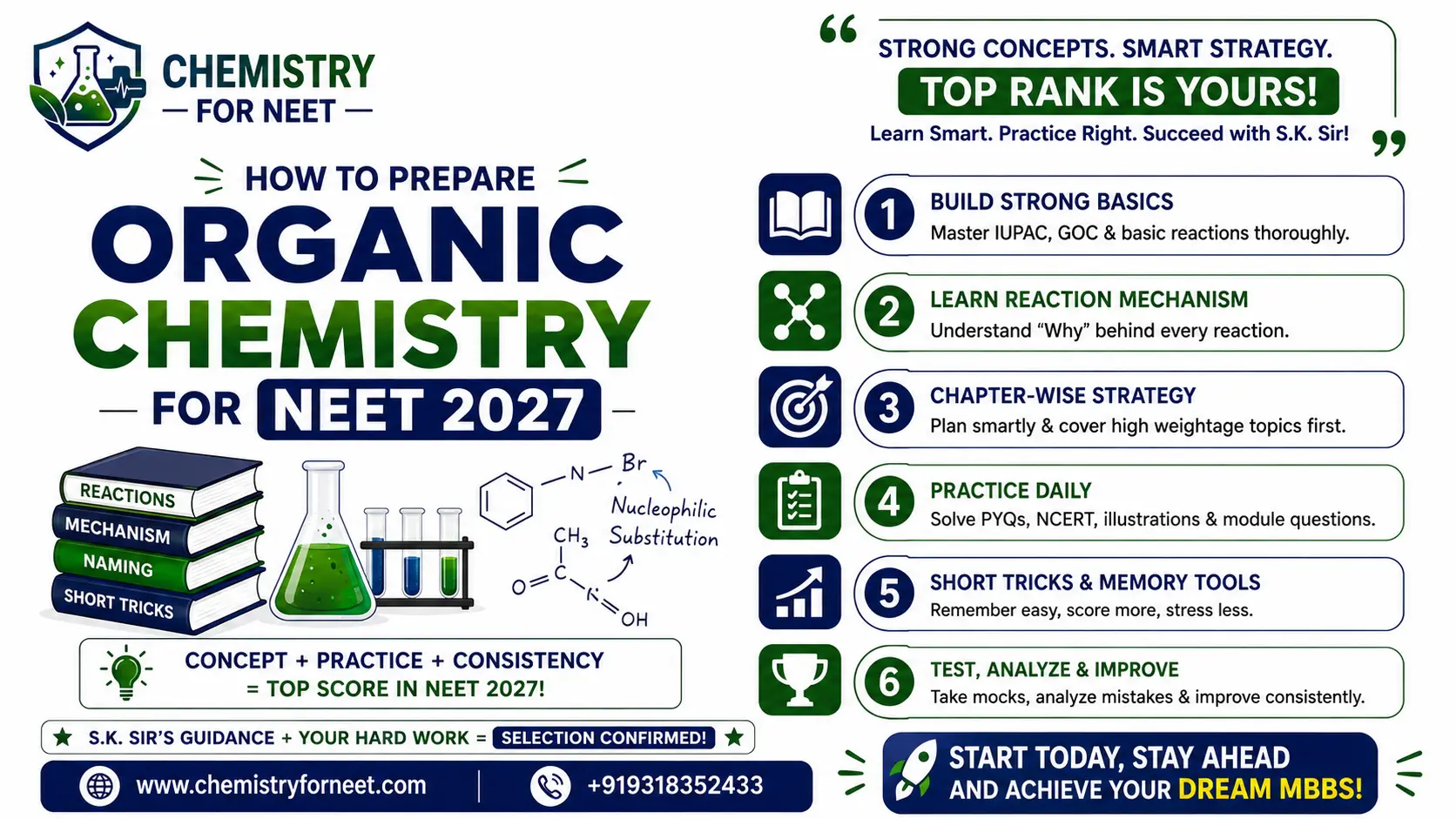
Table of Contents
- Why Organic Is the Most Learnable Section
- Why GOC Comes First, Always
- Reagents Over Reactions: The Core Shift
- Inside a Class: Predict First, Confirm Second
- The Mentorship Behind the Teaching
- Chapter-Wise Guidance and Priorities
- The Organic Chemistry Roadmap for NEET 2027
- Why Students Trust This Approach
- Frequently Asked Questions
Organic Chemistry has a strange reputation among NEET aspirants. Students describe it as the section with "too many reactions to remember," and they arrive with notebooks full of arrows and reagents copied out carefully, none of which they can actually use when a question phrases things slightly differently. Here's what I've come to believe after 18 years of teaching it: Organic Chemistry is genuinely the most learnable of the three sections, and the students who find it hardest are almost always the ones who were taught to memorise it rather than understand it.
This article covers how to prepare Organic Chemistry for NEET 2027 from the teaching side — the methodology, the sequencing, and the reasoning behind both. I've written separately about the five specific reactions every NEET aspirant needs, and I won't repeat that content here. What follows is the layer underneath it: why my organic chemistry strategy for NEET 2027 is built the way it is, what happens inside a class, and how students actually get mentored through the section over a full year.
I'd rather you read this as an argument you can evaluate than a claim you're asked to accept. If the reasoning matches what you've already suspected about why Organic hasn't clicked, that's the most useful signal available. If it doesn't, that's worth knowing too. Either way, organic chemistry preparation for NEET 2027 is a long enough project that choosing the right method matters considerably more than choosing the right week to start.
Why Organic Is the Most Learnable Section
Organic Chemistry for NEET 2027 rewards understanding more directly than any other part of the syllabus, which is precisely why it feels so punishing to students taught the wrong way.
The Rules Are Few, the Applications Are Many
Inorganic Chemistry has genuinely large amounts of information that simply must be retained. Organic doesn't. Underneath every chapter sits a small handful of ideas — electron density, charge stability, how a nucleophile finds an electrophile — applied repeatedly to new molecules. A student who genuinely holds those few ideas can handle reactions they've never seen. A student who memorised two hundred reactions can handle exactly two hundred, and NEET only needs to ask about the two hundred and first.
Memorisation Fails in a Very Specific, Predictable Way
NEET rarely asks a reaction exactly as it appears in NCERT. The examiner swaps a methyl group for an ethyl, adds a substituent, or reverses the direction of a synthesis. A memorised answer collapses at exactly that point, and students experience this as bad luck rather than as the predictable consequence of the method they were taught. Recognising this pattern is usually the first step in fixing it, because a student who understands why they failed can change something specific.
Which Is Why Organic Chemistry From Zero Is Genuinely Achievable
Students frequently arrive convinced they've fallen too far behind to recover. Organic chemistry preparation from zero for NEET is more realistic than in almost any other section, precisely because there's less to accumulate and more to understand. I've taught students who couldn't reliably identify a functional group in month one and were comfortably solving multi-step synthesis questions by month six. That's not an unusual outcome — it's what happens when the foundation gets built properly rather than skipped.
Pro Tip from S.K. Sir:
If your Organic notes are mostly reactions copied out with arrows, and very little written in your own words about why those arrows point where they do, that's the whole problem in one observation. Good Organic notes explain more than they record.
Why GOC Comes First, Always
General Organic Chemistry is the single sequencing decision that shapes everything else in my teaching, and it's the one students most often want to rush past.
GOC Is the Grammar, Not the First Chapter
Inductive effect, resonance, hyperconjugation, and the stability of carbocations and carbanions aren't a chapter to complete and move past — they're the grammar every later chapter is written in. Concept based organic chemistry for NEET means treating GOC as a language being learned rather than content being covered, which is why I spend considerably longer on it than most syllabus plans allocate. You wouldn't try to read a novel in a language whose grammar you'd skimmed once, and Organic Chemistry punishes that shortcut just as reliably.
I Don't Move On Until Stability Ordering Is Automatic
My practical test is simple: show a student four carbocations and ask them to rank stability. If that ranking takes more than a few seconds, or requires visible working, GOC isn't finished regardless of how many sessions we've spent on it. Nearly every later chapter asks a version of this question in disguise — which product forms, which pathway dominates, which site gets attacked — and a student who hesitates here will hesitate everywhere those questions appear.
The Cost of Rushing GOC Shows Up Three Months Later
Students who push past GOC to reach Hydrocarbons faster feel ahead for a few weeks. The bill arrives around Aldehydes and Amines, where nothing quite makes sense and every chapter needs re-teaching. Organic chemistry from basics for NEET means accepting a slower first month in exchange for a dramatically faster second half, and I've never once regretted making that trade with a student. The students who resist it hardest in month one are usually the ones most grateful for it by month five.
Reagents Over Reactions: The Core Shift
If I had to compress my entire neet organic chemistry preparation strategy into one instruction, it would be this: learn what a reagent does, not what a reaction produces.
A Reagent Has a Personality
I teach reagents as characters with consistent behaviour. LiAlH₄ is aggressive and reduces almost anything it meets. NaBH₄ is more selective and leaves esters alone. KMnO₄ oxidises enthusiastically and doesn't much care what it's oxidising. Once a student knows the personality, they can predict behaviour with an unfamiliar substrate — which is exactly the skill NEET tests and exactly what memorising reaction lists never builds. Twenty reagents genuinely understood cover more ground than two hundred reactions memorised, and they hold up on questions nobody has seen before.
Organic Chemistry Mechanism for NEET, Taught as a Story
Every mechanism is a short story about electrons moving from where they are plentiful to where they are scarce. I teach organic chemistry mechanism for NEET as exactly that narrative — this electron pair is here, it's attracted there, here's what breaks, here's what forms. Students who follow the story can reconstruct a mechanism they've partially forgotten. Students who memorised the arrow diagram have nothing to reconstruct, which is why partial recall helps one student and strands the other.
Named Reactions Learned Late, Not Early
Organic chemistry named reactions for NEET matter, and they're worth knowing precisely. But I introduce them only after the underlying mechanisms are secure, so each named reaction lands as a special case of something already understood rather than as a new item to memorise. Taught in this order, students find named reactions genuinely easy. Taught first, the same reactions become an overwhelming list, which is why so many students describe this section as impossible to keep on top of.
Inside a Class: Predict First, Confirm Second
The clearest way to describe a teaching approach is to describe what actually happens in the room, so here's roughly how an Organic session runs.
The Product Stays Covered
When I put a reaction on the board, the product is hidden. Students see reactants and reagent and are asked to predict what forms, before anything is confirmed. This is uncomfortable at first and it's the entire point — organic chemistry problem solving for NEET is a prediction skill, and a student who only ever sees completed reactions is practising recognition instead. Recognition feels like learning and performs badly on exam day, which is a combination worth being alert to.
Wrong Predictions Get Discussed, Not Corrected
When a student predicts incorrectly, my first question is why they expected that product. The reasoning behind a wrong answer is far more instructive than the right answer itself, and it frequently reveals a GOC gap that would otherwise have stayed hidden for months. A class where nobody is willing to guess wrong is a class where very little is actually being learned, so I spend real effort making wrong answers feel safe to offer.
Mechanisms Get Drawn, Not Displayed
Every mechanism is drawn live, arrow by arrow, with the reasoning spoken aloud as it happens. Pre-made animations look impressive and teach considerably less, because they hide the decision points. Watching a mechanism being built shows students how to build one themselves, which is the skill that actually transfers to an unfamiliar question.
Organic Chemistry Reaction Tricks, Taught With Their Limits
There are genuine shortcuts in this section, and I teach them — but always alongside the specific conditions under which they fail. Organic chemistry reaction tricks for NEET that get taught without their limits are actively dangerous, because they produce confident wrong answers on exactly the questions designed to test the exception.
The Mentorship Behind the Teaching
Teaching a chapter and mentoring a student through a subject are different responsibilities, and Organic Chemistry demands the second more than most sections, because progress here is uneven and confidence matters.
I Track Which Reactions Each Student Keeps Missing
Patterns in Organic errors are usually invisible to the student experiencing them. When a particular student misses elimination-versus-substitution questions across three tests, that's a specific, addressable gap — and one they'd almost certainly never have named themselves. A chemistry mentor for NEET 2027 earns their value largely by noticing things the student can't yet see.
Doubts Are Answered by Me, Not Routed Elsewhere
An Organic doubt is rarely just about one reaction. It usually points to a GOC concept that needs revisiting, and recognising that connection requires knowing what the student has already been taught. This is why I answer doubts personally rather than routing them to assistants — the answer depends on context that only the teacher has.
Confidence Gets Managed Deliberately
Organic Chemistry produces a specific kind of discouragement, where a student who understood yesterday's chapter feels lost in today's. I flag this in advance so it isn't experienced as failure, because students who quit the method during that dip never reach the point where it pays off. Managing that expectation is genuinely part of the teaching, not separate from it, and it's one of the clearest differences between teaching a subject and mentoring someone through it.
Small Batches, Because This Doesn't Scale
Everything in this section — tracking individual error patterns, noticing confusion mid-class, answering doubts personally — becomes impossible past a certain batch size. That isn't a marketing position, it's arithmetic. I keep batches small because the teaching described in this article genuinely cannot be delivered otherwise, and I'd rather teach fewer students properly than more students approximately.
Chapter-Wise Guidance and Priorities
Not every chapter deserves equal time, and deciding where a student's limited hours go is one of the more useful judgements a teacher makes on their behalf.
The Organic Chemistry Important Chapters for NEET 2027
Based on our chapter-wise weightage analysis, GOC carries the heaviest weight in the Organic section, with Aldehydes, Ketones and Carboxylic Acids close behind, followed by Hydrocarbons, Haloalkanes and Haloarenes, Alcohols, Phenols and Ethers, Amines, and Biomolecules. GOC's weighting understates its real importance, since it also determines performance in every chapter listed after it.
Organic Chemistry Reactions for NEET 2027, Grouped by Type
I teach reactions grouped by mechanism type — substitutions together, eliminations together, additions together — rather than chapter by chapter. Organic chemistry reactions for NEET 2027 make far more sense this way, because the underlying similarity becomes visible instead of being scattered across five separate chapters that appear unrelated.
PYQs as Teaching Material
Organic chemistry pyqs for NEET are used in class as primary material rather than only as end-of-chapter assessment. Organic chemistry question practice for NEET works best when a student sees ten years of one reaction type together, because the NTA's specific habits become visible in a way no single paper reveals.
Notes That Shrink Over the Year
Good organic chemistry notes for NEET 2027 get shorter as the year progresses, not longer. Once a mechanism is genuinely internalised it can leave the active revision set entirely. A student revising from fifty pages in the final month has usually accumulated rather than learned, and I check for this deliberately with students as the exam approaches.
The Organic Chemistry Roadmap for NEET 2027
Here's the organic chemistry study plan for NEET 2027 I actually run students through. It's deliberately front-loaded, because everything after Phase 2 depends on the foundation built before it.
- Phase 1 — GOC, properly: Electronic effects, resonance, stability ordering, and acid-base behaviour, until stability comparisons are genuinely automatic rather than calculated.
- Phase 2 — Mechanism types: Substitution, elimination, and addition taught as families, with reagent behaviour built alongside them.
- Phase 3 — Functional group chapters: Hydrocarbons through Amines, each treated as GOC applied to a new functional group rather than as fresh material.
- Phase 4 — Named reactions and synthesis: Named reactions introduced as special cases, followed by multi-step synthesis questions that combine several chapters.
- Phase 5 — Testing and consolidation: Chapter-wise PYQs and full-syllabus papers, with the organic chemistry revision strategy for NEET shifting entirely to closing gaps the tests expose.
The sequence matters more than the calendar. A student arriving with solid GOC starts at Phase 2; one who needs longer gets longer. Pushing a student into functional group chapters before Phase 1 holds is the single most common way neet chemistry organic section preparation quietly fails months later.
Why Students Trust This Approach
I'd rather explain what students actually report than assert a reputation, so here's what they and their parents tell me when I ask directly.
They Start Solving Reactions They've Never Seen
This is the moment the method proves itself, and students usually notice it before I do. Correctly predicting the product of an unfamiliar reaction is a qualitatively different experience from recalling a memorised one, and students describe it as the point Organic Chemistry stopped feeling like a memory test. It also tends to change how they approach the rest of the syllabus, because they've now seen firsthand what understanding buys them that memorisation doesn't.
Experience That Shows Up in the Small Decisions
Eighteen years of teaching NEET Chemistry, including earlier years teaching IIT-JEE Chemistry at FIITJEE, mostly shows up in unglamorous ways: knowing which explanation works for which kind of confusion, which chapter to teach before which other one, and which mistakes are worth pre-empting by name. A top organic chemistry teacher for NEET in India is distinguished far more by these small accumulated judgements than by any single dramatic technique, and they're difficult to acquire any way other than by teaching a great many students over a great many years.
Results You Can Independently Verify
Our published results carry real names and colleges specifically so families can check them rather than take a claim on trust. I'd genuinely encourage you to do that — with us and with every other option you're considering. An institute that won't connect you with a former student has told you something useful without intending to.
Frequently Asked Questions
Is it really possible to start Organic Chemistry from zero and still score well?
Yes, and more reliably than in the other two sections. Organic depends on a small number of ideas applied repeatedly rather than a large volume of retained information, which means a student starting late can build the foundation and then move quickly. What genuinely doesn't work is starting from zero and skipping GOC to save time.
How many reactions do I actually need to memorise for NEET?
Fewer than most students assume, provided mechanisms are understood. Named reactions do need to be known precisely, but if you understand what each reagent does, most of what looks like a memorisation load becomes predictable instead. The memorising gets much lighter once the understanding is in place.
How is this different from other organic chemistry classes for NEET 2027?
Mainly three things: GOC is treated as a language rather than a chapter to complete, reactions are grouped by mechanism type instead of by textbook chapter, and products stay hidden so students predict before confirming. Whether that's genuinely different from your current option is best judged by sitting through one class of each.
Is online organic chemistry coaching for NEET as effective as offline?
For this section, yes, provided mechanisms are drawn live rather than shown as finished diagrams. What matters is watching the reasoning unfold. A best online organic chemistry teacher for NEET who builds mechanisms in real time will teach this better than an in-person class relying on pre-made slides.
How long before Organic Chemistry starts feeling manageable?
Usually six to eight weeks, with the first few weeks often feeling slower than expected because GOC is being built rather than chapters being covered. Students frequently report confidence shifting before their scores do, which is the normal order and worth expecting rather than worrying about.
Do I need a separate organic chemistry tutor for NEET, or one Chemistry teacher for everything?
One teacher who genuinely adapts their method to each section is usually better than three specialists, because the sections connect more than students expect. What matters is whether that teacher teaches Organic differently from how they teach Inorganic — using one uniform method across all three is the actual problem worth avoiding.
How do I judge whether someone is the best organic chemistry teacher for NEET 2027 for my child?
Sit through a demo and watch one specific thing: does the teacher explain why electrons move before showing where they end up? That single observation predicts long-term outcomes better than credentials or fees. It's also worth asking directly about batch size and how quickly doubts get answered between classes.
How to score high in Organic Chemistry for NEET if I'm starting late?
Compress the functional group chapters, never GOC. Students who skip the foundation to cover more chapters consistently spend longer undoing that decision than they saved making it. Starting late changes how fast you move through Phases 3 and 4, not whether Phase 1 happens.
See Whether This Teaching Suits You
Everything described here is easier to judge in twenty minutes of a real class than in several thousand words about one. Sit through a free demo, watch a mechanism get built live, and decide for yourself whether it matches what your Organic preparation has been missing.
Book a Free Demo Class