How to Study Inorganic Chemistry for NEET 2027
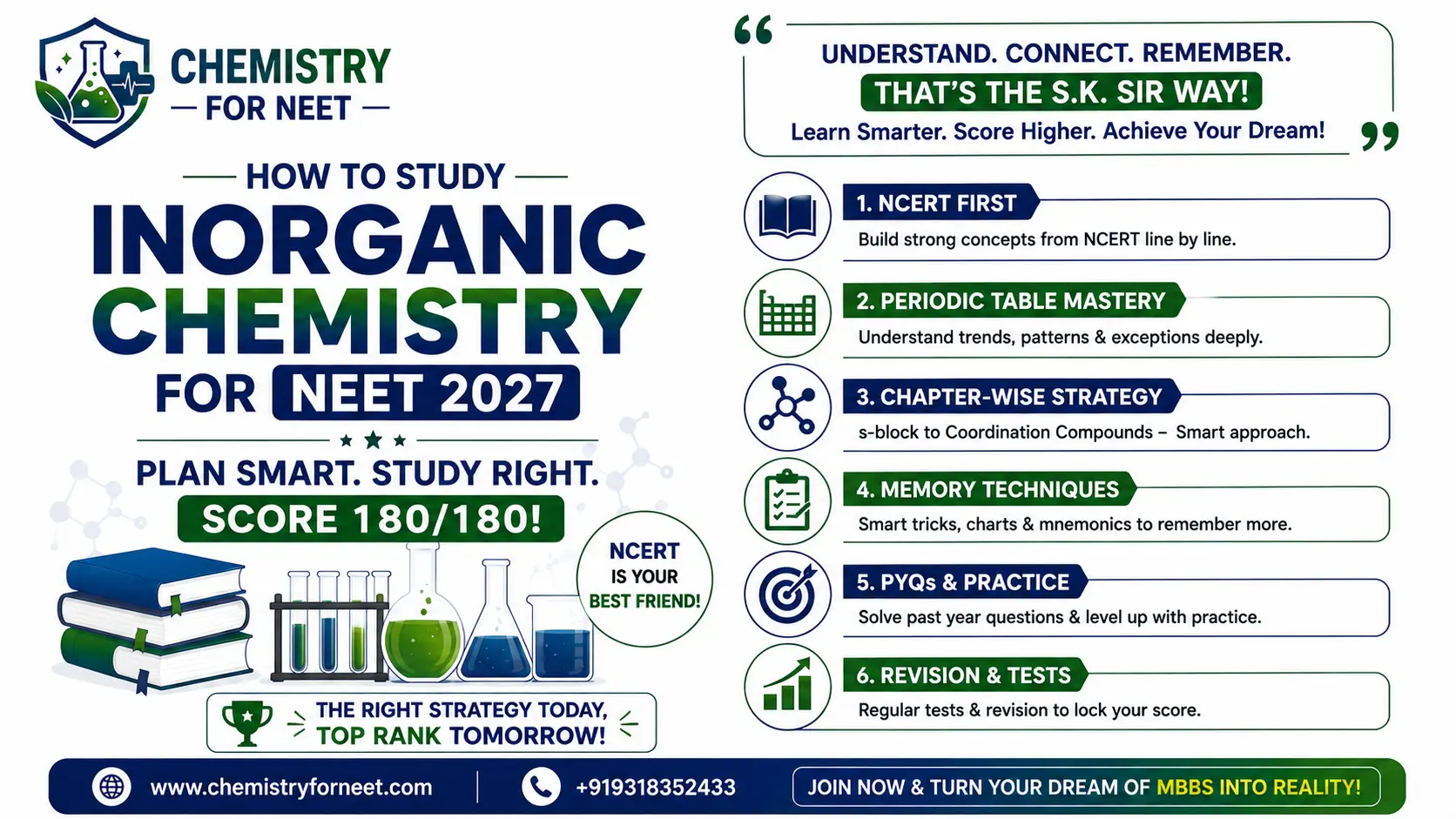
Table of Contents
- The Rote-Learning Myth That Costs Students Marks
- The Method: Patterns Before Facts
- What Genuinely Needs Memorising, and How
- Why NCERT Is the Primary Text Here
- Inside a Class: Teaching the Exception First
- The Mentorship Behind the Teaching
- The Inorganic Chemistry Roadmap for NEET 2027
- Why Students Trust This Approach
- Frequently Asked Questions
Ask a NEET aspirant about Inorganic Chemistry and you'll almost always hear the same sentence: "it's just rote learning." Students repeat it so confidently that it's become received wisdom, and it's doing genuine damage — because a student who believes a subject is pure memorisation will study it by memorising, and Inorganic Chemistry punishes that approach more reliably than most people realise. After 18 years of teaching this section, I'd argue almost the opposite: Inorganic is the most systematic part of NEET Chemistry, and the students who find it impossible are usually the ones nobody showed the system to.
This article covers how to study Inorganic Chemistry for NEET 2027 from the teaching side — the methodology, the sequencing, and the reasoning behind both. I've written separately about the five chapters that decide your Inorganic score, and I won't repeat that content. What follows is the layer underneath: why my inorganic chemistry strategy for NEET 2027 works the way it does, what happens inside a class, and how students get mentored through the section across a full year.
Read this as an argument you can evaluate rather than a claim you're asked to accept. If the reasoning matches what you've already suspected about why this section hasn't stuck, that's the most useful signal available. Either way, inorganic chemistry preparation for NEET 2027 is a long enough project that choosing the right method matters considerably more than choosing the right week to begin.
The Rote-Learning Myth That Costs Students Marks
Inorganic chemistry for NEET 2027 suffers from a reputation that is half-true in a way that makes it more damaging than an outright falsehood would be.
Yes, There Are Facts. No, It Isn't Only Facts.
Some Inorganic content genuinely must be memorised — the colour of a particular complex, a specific oxidation state, certain named compounds. That's real, and I won't pretend otherwise. But it's a far smaller fraction than students assume. Most of what looks like an enormous pile of unconnected facts is actually periodic trends applied repeatedly across different groups and blocks, and once a student sees that, the pile shrinks dramatically.
NEET Tests Exceptions, Which Memorisation Handles Badly
Here's the specific reason rote learning underperforms here. NEET rarely asks a straightforward trend question — those are too easy to differentiate anyone. It asks about the exceptions: why chlorine's electron gain enthalpy exceeds fluorine's, why boron breaks the melting point pattern. An exception is only learnable as an exception if you genuinely understand the rule it's breaking. Students who memorised the rule as a fact have no framework for the exception, and simply add it to the pile as one more disconnected item — which is why the pile keeps growing and never becomes easier to carry.
Which Is Why Starting From Zero Is Genuinely Feasible
Students often arrive convinced this section is beyond recovery. Inorganic chemistry preparation from zero for NEET is more achievable than most expect, precisely because the underlying system is compact. Building inorganic chemistry from basics for NEET means starting with Chemical Bonding and periodicity rather than with the block chapters, and once those two are properly built, the p-block and d-block stop being separate mountains to climb and start being applications of something already understood. I've seen this shift happen often enough to treat it as the normal outcome rather than a surprising one.
Pro Tip from S.K. Sir:
If your Inorganic notes are a long list of properties with nothing explaining why those properties occur, you're carrying far more memory load than the subject actually requires. Try rewriting one group's properties with a "because" attached to each — most of the list will collapse into two or three underlying reasons.
The Method: Patterns Before Facts
Concept based inorganic chemistry for NEET means teaching the machinery that generates the facts before teaching the facts themselves. It's slower at the start and considerably faster afterwards.
Chemical Bonding Is Taught as Infrastructure
Hybridisation, VSEPR, and Molecular Orbital Theory aren't one chapter among many — they explain the shape, stability, magnetic behaviour, and reactivity of almost everything that follows. I treat Chemical Bonding the way I treat GOC in Organic: as infrastructure the rest of the section is built on. Students who rush it end up re-deriving the same logic separately in every later chapter, which is a slower route to the same destination.
Every Fact Gets a "Because"
In my classes, a property is never stated without the reason attached in the same breath. Not "ionisation enthalpy increases across a period," but "increases across a period because nuclear charge grows while the shell stays the same." This costs perhaps twenty percent more time per fact and reduces what a student has to memorise by considerably more than twenty percent, because reasons compress and isolated facts don't. Twenty properties sharing three underlying reasons is a far lighter memory load than twenty independent items, even though it looks identical on the page.
Groups Are Taught Horizontally, Not Chapter by Chapter
Rather than working through the p-block group by group in textbook order, I teach a single property across all groups at once — all the ionic radii together, then all the oxidation states together. Neet chemistry inorganic section preparation makes far more sense taught this way, because the pattern is visible when the data sits side by side and invisible when it's scattered across six separate chapters read weeks apart. Students frequently tell me this single change did more for their retention than any amount of additional revision had.
What Genuinely Needs Memorising, and How
I'm not going to claim nothing needs memorising — that would be dishonest and students would discover it quickly. The useful contribution a teacher makes is being precise about which parts those are, and then teaching them efficiently.
Separating the Two Piles, Explicitly
Early in every chapter I tell students exactly which content is derivable and which must simply be known. Colours of transition metal ions, specific named compounds, a handful of anomalous values — these go in the memorise pile. Everything else is derivable. Students consistently report that simply knowing the memorise pile is small makes the whole section feel manageable, and that shift in perception matters more than it sounds.
Inorganic Chemistry Memorization Techniques That Actually Hold
For the genuinely memorisable core, I teach specific inorganic chemistry memorization techniques for NEET: mnemonics built around sequence rather than isolated items, visual colour charts grouped by metal, and spaced repetition timed to a schedule rather than done whenever it occurs to a student. Inorganic chemistry tricks for NEET work well for this narrow band of content — the error is applying them to the eighty percent that should have been understood instead, which is exactly what happens when a student decides the whole section is a memory exercise.
The Exceptions Register
Every student I teach maintains a single running document of exceptions — every anomalous value, every trend break, with the reason where one exists. Because NEET concentrates its questions exactly here, this document becomes the highest-value revision material a student owns by the final months, and it's genuinely more useful than any set of general inorganic chemistry notes for NEET 2027 covering the whole syllabus evenly. It also has the advantage of being built gradually rather than assembled in a panic during the last few weeks.
Why NCERT Is the Primary Text Here
Inorganic is the section where NCERT dominance is most absolute, and where straying from it costs students the most time for the least return.
The Questions Come From Lines, Not Just Chapters
Inorganic chemistry NCERT for NEET 2027 needs reading at sentence level, not chapter level. NEET has repeatedly built questions from a single line inside a paragraph, a value in a table, or a footnote most students skim past entirely. In class I read specific NCERT lines aloud and mark them, because pointing at the exact sentence a past question came from teaches attention in a way general advice to "read NCERT thoroughly" never does. Students start reading differently after two or three of those demonstrations.
Reference Books Add Volume, Not Marks
For this section specifically, thick reference books tend to add content NEET doesn't test while consuming time that NCERT deserved. Genuine NCERT inorganic chemistry preparation for NEET means reading the actual textbook repeatedly and closely, with supplementary notes used only to condense it for revision — never to replace it as the source of truth. This is one of the few places in NEET preparation where doing less, more carefully, genuinely outperforms doing more.
Inside a Class: Teaching the Exception First
Describing a teaching style is easiest by describing what actually happens in the room, so here's roughly how an Inorganic session runs.
I Open With the Anomaly, Not the Rule
Rather than stating a trend and mentioning exceptions afterwards, I frequently open with the anomaly itself — why does this element misbehave? Working backwards from the exception forces students to construct the rule to explain it, which produces far better retention than receiving the rule pre-formed. It also front-loads exactly the content NEET is most likely to test, so the highest-value material gets the freshest attention rather than arriving as a tired footnote at the end of a long chapter.
Students Predict Properties Before Being Told
Given a position in the periodic table, students are asked to predict properties before I confirm anything. Getting a prediction wrong reveals precisely which part of the underlying model is faulty, which is far more useful diagnostically than a correct answer would be. Inorganic chemistry question practice for NEET works the same way — the wrong answers carry the teaching value, which is why I spend real effort making wrong answers feel safe to offer in class.
PYQs Used to Show Where NEET Actually Looks
Inorganic chemistry pyqs for NEET get used in class as primary teaching material. When students see ten years of questions from one chapter together, the NTA's habits become obvious — which sub-topics recur, which exceptions get asked repeatedly, which areas are largely ignored. That visibility is difficult to acquire any other way and immediately changes how a student allocates revision time.
The Mentorship Behind the Teaching
Inorganic Chemistry needs a particular kind of mentoring, because its failure mode is silent — material fades gradually rather than collapsing visibly, and students rarely notice until a test reveals it.
I Track Decay, Not Just Understanding
A student can genuinely understand the d-block in October and have lost a third of it by January without noticing. I deliberately re-test older Inorganic chapters at intervals rather than assuming a chapter taught is a chapter retained, because in this section that assumption is unusually unsafe. Catching decay early is one of the more valuable things a chemistry mentor for NEET 2027 does that a student cannot easily do alone, precisely because forgetting is invisible from the inside — nothing feels different until a test reveals the gap.
Doubts Answered Personally, Because Context Matters
An Inorganic doubt is usually a symptom rather than the problem. A student confused about a coordination compound's magnetic behaviour typically has a Chemical Bonding gap underneath, and recognising that connection requires knowing what they've already been taught and where they've struggled before. That's why I answer doubts myself rather than routing them elsewhere — the useful answer depends on context only the teacher holds.
Small Batches, Because This Doesn't Scale
Tracking individual retention patterns, noticing which student has quietly lost the p-block, answering doubts with full context — none of this survives past a certain batch size. That's arithmetic rather than marketing. I keep batches deliberately small because the teaching described in this article genuinely cannot be delivered otherwise.
The Inorganic Chemistry Roadmap for NEET 2027
Here's the inorganic chemistry study plan for NEET 2027 I actually run students through. It's deliberately ordered so that each phase supplies what the next one assumes, and it prioritises the inorganic chemistry important chapters for NEET 2027 identified in our chapter-wise weightage analysis rather than spreading time evenly across the syllabus.
- Phase 1 — Chemical Bonding: Hybridisation, VSEPR, and MOT built properly, since every later chapter depends on this being genuinely solid rather than merely covered.
- Phase 2 — Periodicity as a system: Every major trend with its underlying reason and its principal exceptions, taught as the engine that generates later content.
- Phase 3 — p-block, taught horizontally: Properties compared across groups rather than group by group, so patterns stay visible.
- Phase 4 — d- and f-block: Where the memorise pile is largest, with memorisation techniques applied deliberately to that narrow band.
- Phase 5 — Coordination Compounds: Taught last among the core chapters, because it draws on Chemical Bonding most heavily and lands easily once that's secure.
- Phase 6 — Testing and retention: Chapter-wise PYQs and spaced re-testing, with the inorganic chemistry revision strategy for NEET focused on fighting decay rather than covering new ground.
Sequence matters more than calendar. A student arriving with Chemical Bonding already solid starts at Phase 2; one who needs longer gets longer. Pushing forward before Phase 1 holds is the most common way neet inorganic chemistry preparation strategy quietly fails several months later, and it's almost always avoidable.
Why Students Trust This Approach
Rather than assert a reputation, here's what students and parents actually report when I ask them directly.
The Memory Load Drops Noticeably
This is the change students mention most often, usually within the first two months. Discovering that most of what they'd been memorising is derivable produces genuine relief, and it converts Inorganic from the section they postpone into one they're willing to revise. That shift shows up in scores a month or two after it shows up in attitude, which is the normal order and worth expecting rather than worrying about.
They Stop Treating It as the Section to Cram Last
Students routinely arrive planning to leave Inorganic for the final month, on the theory that memorised content is best kept fresh. There's a grain of truth in that for the small memorise pile, and it's disastrous applied to the section as a whole, since the pattern-based majority needs time to build. Watching a student move Inorganic from last place to first in their own schedule is usually the clearest sign the approach has genuinely landed.
Experience That Shows in Small Judgements
Eighteen years teaching NEET Chemistry, including earlier years on IIT-JEE Chemistry at FIITJEE, shows up mostly in unglamorous decisions: which exception to flag before students meet it, which chapter to teach before which other, which explanation works for which kind of confusion. A top inorganic chemistry teacher for NEET in India is distinguished far more by these accumulated judgements than by any single technique, and they're hard to acquire except by teaching a lot of students over a lot of years.
Results You Can Independently Verify
Our published results carry real names and colleges specifically so families can check them rather than take a claim on trust. I'd encourage you to do exactly that, with us and with every alternative you're weighing. Any institute unwilling to connect you with a former student has told you something useful without meaning to.
Frequently Asked Questions
Isn't Inorganic Chemistry mostly memorisation regardless of how it's taught?
A portion of it genuinely is, and I won't pretend otherwise. But in my experience the memorisable core is far smaller than students assume — most of what feels like an endless list of facts is periodic trends applied repeatedly. The teacher's job is being precise about which parts are which, so effort goes where it's actually needed.
I keep forgetting Inorganic even after revising. What am I doing wrong?
Almost certainly revising material that was memorised rather than understood — memorised facts decay quickly and revision only slows that decay slightly. Facts attached to reasons behave differently, because a forgotten detail can be reconstructed from the underlying principle rather than needing to be relearned from scratch.
Do I need reference books, or is NCERT genuinely enough?
For Inorganic specifically, NCERT is genuinely enough, read closely and repeatedly at sentence level rather than skimmed at chapter level. Additional material is useful for condensing content into revision form, but reference books tend to add volume NEET doesn't test while consuming time NCERT deserved.
How is this different from other inorganic chemistry classes for NEET 2027?
Three things mainly: every fact is taught with its reason attached, groups are taught horizontally so patterns stay visible, and exceptions are taught before rules rather than as afterthoughts. Whether that's genuinely different from your current option is best judged by sitting through one class of each and comparing directly.
Is online inorganic chemistry coaching for NEET as effective as offline?
Yes, provided the teaching is genuinely live and reasoning is built in real time. This section depends less on live problem-solving than Physical Chemistry does, so a best online inorganic chemistry teacher for NEET is at little disadvantage — what matters is whether reasons are taught alongside facts, not the delivery format.
How do I judge whether someone is the best inorganic chemistry teacher for NEET 2027 for my child?
Sit through a demo and listen for one thing: does the teacher say "because" after stating a property, or simply state it and move on? That single observation predicts long-term retention better than credentials or fees. It's also worth asking directly about batch size and how quickly doubts get answered between classes.
How to score high in Inorganic Chemistry for NEET if I'm starting late?
Build Chemical Bonding and periodicity properly even under time pressure, then compress the block chapters — never the reverse. Students who skip the foundation to cover more chapters consistently spend longer undoing that decision than they saved. Starting late changes pace, not sequence.
Do I need a separate inorganic chemistry tutor for NEET, or one Chemistry teacher?
One teacher who adapts their method per section is usually better than three specialists, since the sections connect more than students expect. What matters is whether Inorganic is taught differently from Physical and Organic — using one uniform approach across all three is the actual problem worth avoiding.
See Whether This Teaching Suits You
Everything described here is easier to judge in twenty minutes of a real class than in several thousand words about one. Sit through a free demo, listen for whether every property arrives with a reason attached, and decide for yourself whether it matches what your Inorganic preparation has been missing.
Book a Free Demo Class